“MANAV” AI Vision: PM Modi Demands Transparent, Human-Centric Framework
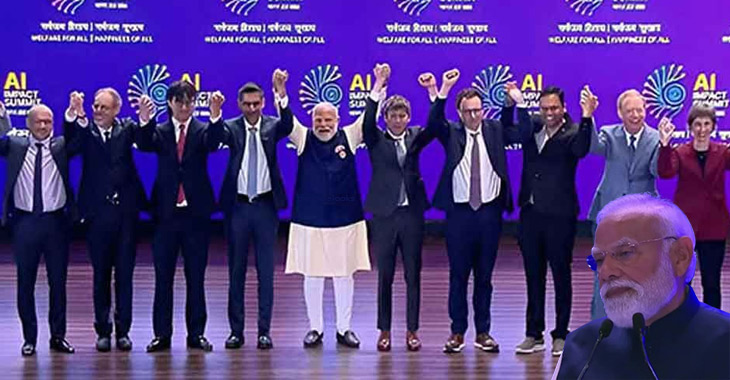
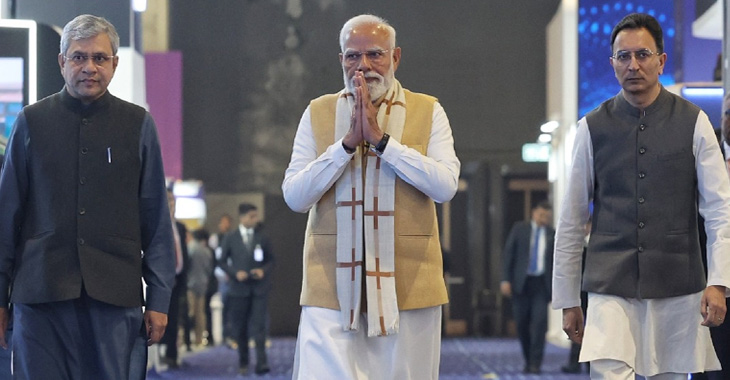
In his Thursday speech, Prime Minister Narendra Modi described a holistic and human-centric approach to Artificial Intelligence (AI) known as MANAV, urging the international community to strike a balance between innovation and responsibility as it works to define the future of AI.
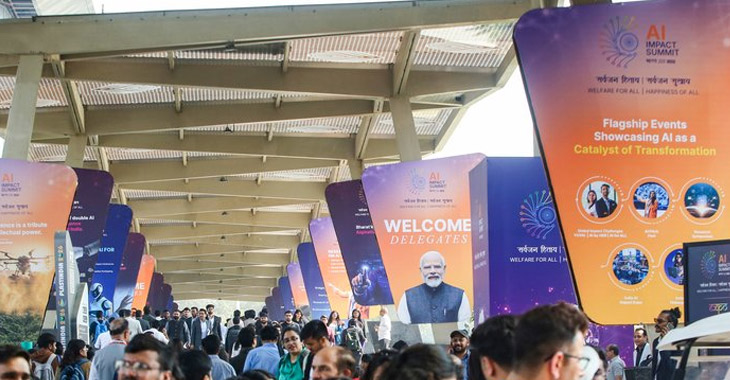
In his address to the India-AI Impact Summit 2026, the Prime Minister stated that the globe has a “big vision and an equally big responsibility” in the age of artificial intelligence.
“In addition to the current generation, we must also consider what type of AI we will be passing on to future generations. The genuine issue now is, then, not what AI will be able to accomplish in the future. The issue is, what should we do with artificial intelligence right now? Humanity has faced such questions in the past. Nuclear energy is the best illustration. Its destruction has been witnessed, as well as its beneficial impact,” he stated.
Modi warned against the abuse of AI, calling it a revolutionary technology.
“AI has the capacity to change things as well. If it lacks direction, it will cause havoc; He emphasized the importance of using the technology ethically and responsibly, stating that “it will become a solution if it goes in the right direction. ”
As India’s human-centric framework for the 21st century, the Prime Minister unveiled what he termed the ‘MANAV’ vision for AI.
“We must provide AI an open sky, but also maintain control over the command. The ultimate decision on which direction to go is still ours, even though GPS proposes the route. Our future will depend on the path we choose for AI right now. I am introducing the ‘MANAV’ vision for AI at the New Delhi AI Impact Summit today; it stands for a human-centric Indian perspective on AI, as the term suggests,” he stated.
He broke down the acronym as follows: “M stands for Moral & Ethical Systems, which means AI must be guided by ethics and respect human values; A for Accountable Governance, transparent rules, robust oversight, and national sovereignty, Whoever owns the data must own the rights; N for Accessible and Inclusive, AI must not become a monopoly, but a multiplier of opportunities; A for Valued and Legitimate, AI must be lawful, trustworthy, and socially accepted; V for Vision for Humanity, the ultimate goal of AI must be the welfare of humanity. ”
“India’s MANAV Vision will offer meaningful direction for human welfare in an AI-driven 21st Century world. ” Human values will determine the future of technology, not machines, he said.
In emphasizing the value of openness, Prime Minister Modi emphasized transparency as a protection against the advancement of artificial intelligence.
‘Sunlight is the best disinfectant’ is a common saying, implying that transparency provides the best protection. AI is considered a strategic asset by certain nations and businesses, and its development should be kept under wraps. According to him, “India thinks differently. ”
“We think AI will only benefit global interests if it is shared, if codes are open, and if innovation is collective. ” Only then will millions of young brains be able to improve it and make it safer. Let us pledge to create AI as a global public benefit,” he said.
The Prime Minister cautioned about new dangers like deepfakes and tampered digital material, urging the creation of worldwide standards.
“There is also an urgent necessity to develop global standards. Open societies can be made unstable by fake news and deepfakes. We can see nutrition labels on food in the real world to tell us what we are eating. In the same vein, in the digital realm, content should be labeled with authenticity marks, he added.
“People need to be able to distinguish between what is real and what is created by AI. ” The requirement for watermarking and transparent source standards will increase as AI produces text, images, and videos. Technology needs to have trust built in from the start,” he said.
Addressing worries about the safety of children, Modi stated that measures in the AI environment must be improved.
“We have to be even more cautious about the welfare of children. The AI environment should be family-led and child-safe, much like school curricula are curated,” he stated.
The Prime Minister stated, “There are two kinds of people in the world today,” when considering the larger perspective on AI. In AI, one may observe dread. The other views AI as a source of fortune. With a sense of pride and responsibility, I declare that India sees prospects in artificial intelligence, not dread. India sees its future in AI.
“We have talent, energy, capacity, and policy clarity,” he said.
“I am delighted to inform you that at this Summit, three Indian firms have introduced their AI models and apps. ” These models demonstrate the breadth and variety of India’s young talent and the solutions India provides to the globe, he said.