Govt unveiled a 30 kW indigenous system to increase EV mobility
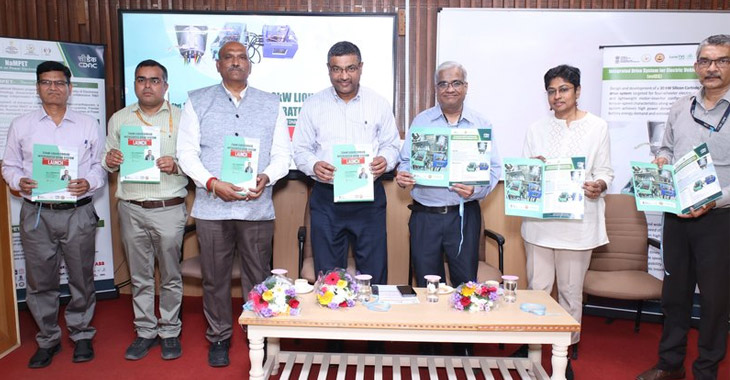
The government revealed a 30 kW Wide Band Gap (WBG)-based Integrated Drive System (IDS) for electric vehicles (EVs) at IIT Madras on Monday, marking a significant step toward bolstering domestic capabilities in advanced power electronics.
According to the Ministry of Electronics and Information Technology (MeitY), the system was created by the Center for Development of Advanced Computing (C-DAC), Thiruvananthapuram, in cooperation with Lucas TVS and the Indian Institute of Technology Madras under the National Mission on Power Electronics Technology (NaMPET).
For India’s rapidly expanding electric passenger vehicle market, which includes fleet mobility platforms and tiny vehicles, the 30-kW power class is especially pertinent.
Currently, a significant amount of crucial semiconductor-based drive components and high-performance EV powertrain systems are imported.
According to the ministry, indigenous development of such integrated systems is anticipated to lessen reliance on imports, lower system costs through localization, and boost scalable manufacturing in line with national programs like the Production-Linked Incentive (PLI) schemes.
IT Secretary S. Krishnan stated during the technology’s debut that the domestic development of cutting-edge power electronics technologies is realizing Prime Minister Narendra Modi’s vision of “Make in India, Make for the World.”
Krishnan continued, “Collaborative innovation among R&D institutes, academia, and business is strengthening India’s shift from a technology-importing nation to a technology-developing and exporting nation.”
In terms of strategic electronics and electric mobility, the creation of the 30 kW Integrated Drive System is a significant turning point in India’s progress toward “Aatmanirbhar Bharat.”
It replaces the traditional separate motor-drive design by combining the electric motor and inverter into a single, small, high power-density unit. Krishnan added, “Design-led innovation in India will assist enhance high-value manufacturing in the EV industry, accelerate the start-up ecosystem, and build strong domestic intellectual property.”
The government claims that the effective implementation of this integrated drive technology can boost India’s global competitiveness in semiconductor-based electric mobility solutions, greatly strengthen the country’s EV supply chain, and open doors for MSMEs in the production of power electronics, thermal systems, and control hardware.