Future green jobs from the renewable and electric vehicle sectors will be enormous
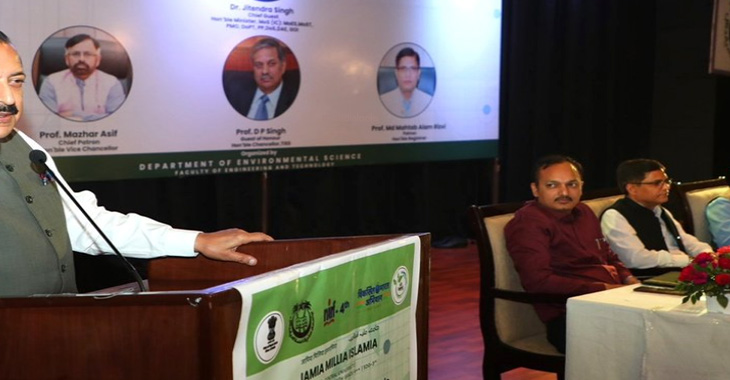
Union Minister Dr. Jitendra Singh stated on Thursday that as India speeds its transition to a green economy, the renewable energy and electric mobility industries are predicted to create a significant number of job prospects in the coming years.
The minister spoke at a conference on environmental sustainability held at Jamia Millia Islamia on the occasion of Earth Day. The conference focused on developing green industries such as renewable energy, electric mobility, green fuels, and the circular economy, all of which will be essential for job creation, particularly for young people.
According to him, “Green jobs and green entrepreneurship are poised to become the defining driver of the future Green Economy, with sectors such as renewable energy, electric mobility, green fuels, and circular economy generating large-scale employment opportunities for the youth.”
He pointed out that the transition to a low-carbon economy would not only generate jobs but also bolster India’s path toward sustainable development.
The minister highlighted significant initiatives, stating that programs like the National Green Hydrogen Mission, with a budget of more than Rs 19,000 crore, are paving the way for a clean industrial revolution and the decarbonization of industries like steel and cement.
He cited instances from the electric mobility field where old cars are being transformed into electric ones, making solutions more accessible and scalable, as examples of how rapid technological advancements are opening up new avenues for green innovation.
The minister emphasized the emerging prospects in solar manufacturing, battery production, grid management, and biofuels, and noted that circular economy approaches like turning used cooking oil into biofuel have considerable entrepreneurial potential.
The minister said that, despite India’s long coastline, ocean energy is still largely untapped and is anticipated to supplement solar and wind energy in the future.
Regarding energy security, he stated that the country is increasing its nuclear power generation capacity and encouraging private sector involvement in strategic industries like space and atomic energy in order to foster innovation and investment.
In addition, he emphasized the Rs 1 lakh crore Research, Development, and Innovation (RDI) Fund, which aims to assist entrepreneurs and innovators by utilizing cooperative funding models.
Regarding India’s global role in climate action, the minister stated that the nation is well-placed to lead the green transition, guided by the ‘Lifestyle for Environment (LiFE)‘ vision.
Additionally, he emphasized the importance of students and young scientists actively participating in sustainability-driven opportunities, stating that future development will be influenced by innovation, flexibility, and wise decisions.