
WTO changes must be member-driven and inclusive
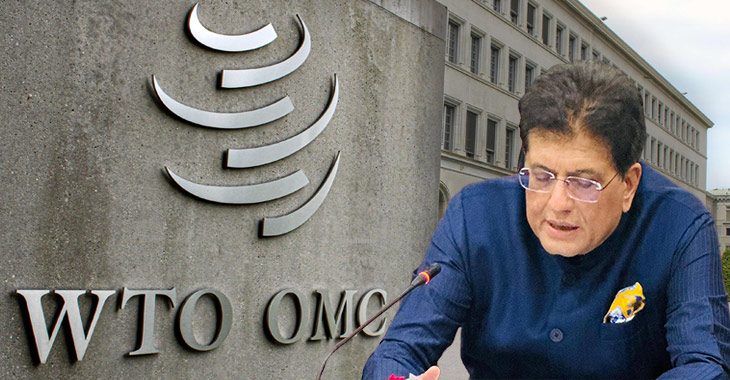
At the current 14th Ministerial Conference (MC14) in Yaounde, Cameroon, Union Commerce and Industry Minister Piyush Goyal stated that WTO reforms must be carried out in a transparent, inclusive, and member-led manner, with development as its central focus, according to an official release on Friday.
He also emphasized the importance of maintaining fundamental principles like equity, consensus-based decision-making, and non-discrimination.
During the conference’s sidelines, Goyal spoke with Cameroonian Prime Minister Joseph Dion Ngute about bilateral and multilateral matters, such as how to improve India-Cameroon ties.
The leaders also talked about fundamental WTO concerns, such as its underlying principles.
Goyal held individual meetings with his counterparts from the Netherlands, France, and Ethiopia to discuss bilateral trade relations, and he also met with WTO Director-General Ngozi Okonjo-Iweala to discuss the MC14 agenda.
In the interim, Rajesh Agrawal, the commerce secretary, met bilaterally with his counterparts from Chile, Paraguay, the US, Nepal, the Philippines, Saudi Arabia, Mexico, Peru, Russia, and New Zealand, as well as with a group of lawmakers from the European Union.
The World Trade Organization’s (WTO) MC14 began on March 26 in Yaounde with an official ceremony presided over by Cameroon’s Trade Minister, and it will end on March 29.
WTO Director-General Ngozi Okonjo-Iweala, trade ministers, and high-level representatives from member states were all present at the inaugural session.
The Agreement on Fisheries Subsidies went into effect after a short ceremony that took place after the session.
The conversation centered on the MC14 agenda and ways to improve bilateral trade relations. Ongoing free trade agreement (FTA) negotiations were also discussed during discussions with Chile and Peru, and advancements in the various FTA talks were assessed during meetings with the European Union and New Zealand.
India also restated that, as stated in the Marrakesh Agreement, non-discrimination continues to be a cornerstone of the WTO framework. The country also stressed the need for a development-focused agenda, which includes the reestablishment of a fully functioning dispute resolution mechanism, effective Special and Differential Treatment (S&DT) provisions for developing and least developed nations (LDCs), and a permanent solution for public stockholding (PSH) for food security.