
The largest obstacle facing AI is power
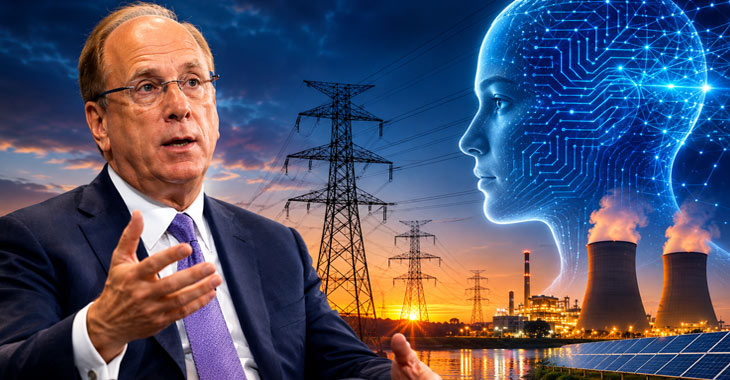
BlackRock‘s Chairman and Chief Executive, Larry Fink, has stated that the greatest challenge facing artificial intelligence is no longer sophisticated computer chips but rather a lack of access to electricity, warning that the United States must update its obsolete power grid or risk delaying the next wave of technical innovation.
According to an interview with Fareed Zakaria GPS on CNN, Fink stated that the exponential rise of AI is driving an unparalleled need for computer power, which is revealing vulnerabilities in the country’s electrical grid.
Fink said that the lack of electricity is the biggest obstacle to AI development, saying that there isn’t enough power in the United States.
He stated that the US has enough energy resources, especially natural gas, but lacks the necessary transmission infrastructure to distribute electricity efficiently.
According to him, the nation possesses enough power from natural gas, but it is unable to distribute it effectively. He further stated that the country would need to invest hundreds of billions of dollars to grow and enhance its power grid.
He said that we won’t be successful in artificial intelligence if we don’t do that. Artificial intelligence is simply a collection of electrons. You therefore require the ability to produce the electrons.
Demand for AI computing capacity now outpaces supply, creating shortages in electricity and other critical infrastructure as well as advanced chips, according to Fink.
There is more demand than supply at this time, he stated. Right now, the United States is facing a lack of computing power, which I believe to be the greatest issue confronting the nation.
He cautioned that unless computer expenses decrease dramatically, smaller businesses may find it difficult to profit from the AI revolution.
Fink stated, “I’m not worried about BlackRock or J. P. Morgan having the cash to invest in these models. However, I’m quite concerned about hospitals and municipalities. Is there going to be an investment in this?
He called for increased access to AI technologies, stating that the United States must democratize AI so that small enterprises, hospitals, local governments, and transport systems may also utilize advanced AI technologies.
He stated that if we are unable to do that, we will encounter some significant structural issues.
Despite enormous investment in artificial intelligence, Fink also disregarded worries that equity markets are in a speculative bubble. Instead, he claimed that abnormally high demand had created shortages that permitted certain businesses to charge significantly higher prices for their goods.
According to Fink, the global economy’s robustness has been demonstrated by recent geopolitical crises, such as the conflict involving Iran.
He said that the global economy significantly reduced many of the pressures by diversifying supply, increasing energy output, and using technological improvements. We address problems.
Fink contended that ongoing economic expansion was the most effective method for controlling the country’s rising government debt.
He advised policymakers to encourage private investment and simplify infrastructure approvals rather than depend on higher taxes, stating that “we’re in trouble if we can’t grow the economy by three percent a year. “