
India leads the major push for renewable energy in the Global South
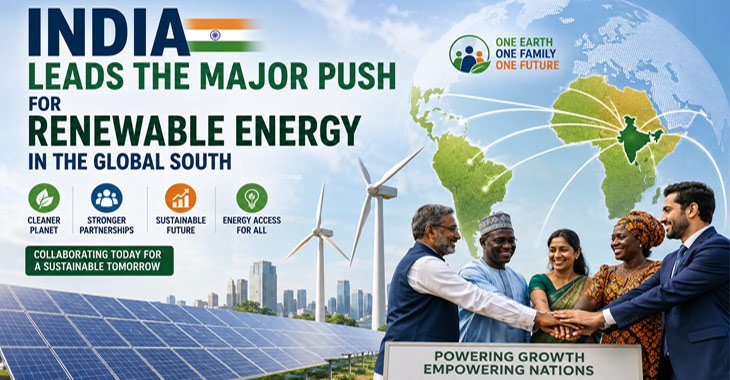
India is taking the lead among Global South nations in promoting collaboration for the sustainable exploitation of renewable resources, which are becoming more important in light of the Middle East crisis‘ disruptions to energy supply.
India co-founded the International Solar Alliance (ISA) with France in 2015 and serves as the ISA’s international headquarters in Greater Delhi (NCR), according to the article, which describes India as a “technology and knowledge-sharing center. ”
The intergovernmental organisation, which is based on treaties, currently has 124 signatory member countries and hopes to raise $1 trillion in solar investments by 2030, mostly through its Global Solar Facility, a payment guarantee fund established by ISA to promote solar power projects.
India’s attempts have been applauded at a moment when the Manila-based ADB and Asian countries are pursuing a significant push toward renewable energy sources.
The Ministry of New and Renewable Energy will host the Bharat Renewable Energy Summit & Expo in New Delhi in November 2026.
According to the paper, over 50,000 delegates are anticipated to attend this event, which will coincide with the 9th ISA Assembly and the 4th International Conference on Green Hydrogen.
The Joint Working Group on Renewable Energy has enabled India and the Philippines to form a significant partnership in the field of clean energy, according to the article.
India has also built significant bilateral collaborations with Australia, Germany, the Netherlands, and the European Union.
According to the piece by J. Albert Gamboa, this includes the recently agreed upon new energy treaty with Australia that addresses critical minerals and renewable energy.
India’s goal of achieving net-zero greenhouse gas emissions by 2070 is supported by domestic momentum. This long-term vision, which was originally a component of the subcontinent’s climate action plan, necessitates a significant structural reform of the energy, transportation, and industrial sectors of the nation.
It has achieved 288 GW of overall renewable capacity by the middle of 2026, and it is on pace to meet its target of 500 GW by 2030.
India promotes Africa’s dispersed renewable energy sector by utilizing ISA as its primary instrument for technological transfer and financial risk reduction.
The deployment of clean power mini-grids to alleviate energy poverty in underserved African areas is a component of this Global South plan.
A blended finance platform created to free up private commercial capital, the Africa Solar Facility is how the collaboration operates.
According to the report, “these initiatives collectively represent India’s endeavor to turn its economic size and diplomatic clout as the world’s most populous nation into true leadership on sustainability for the Global South. “