
Global market for securing AI to hit $4.8B in 2027
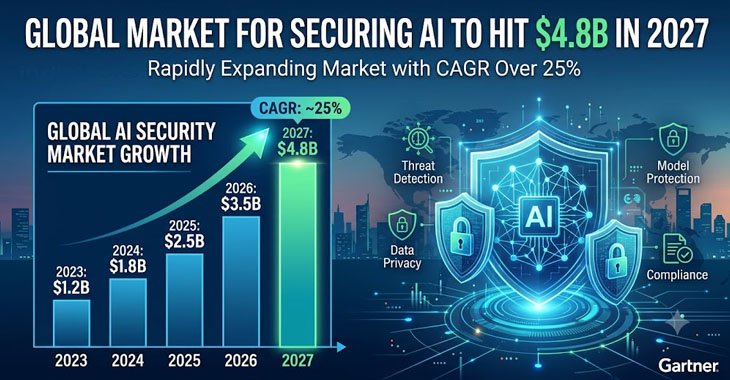
A Gartner report released on Wednesday forecasts that the global market for securing AI will reach nearly $4.8 billion in 2027—a 68.7 percent jump over 2026.
By 2028, Gartner projects the market will hit nearly $7.7 billion.
“The urgent need for enterprises to secure AI systems, address emerging vulnerabilities, and strengthen defenses against sophisticated cyberthreats drives this surge,” said Shailendra Upadhyay, senior principal analyst at Gartner.
Growing vulnerabilities and supply-chain attacks involving third-party and open-source software in AI projects compound the issue. Upadhyay noted that without adequate security and visibility controls, enterprise AI initiatives face a high risk of failure.
By 2029, Gartner expects access control weaknesses and prompt injections to account for over half of successful cyberattacks on AI agents.
AI application security will remain the largest spending category in 2027, reaching almost $851 million, while AI usage control will follow at $749 million.
However, AI usage control will experience the fastest growth rate at 73 percent, with AI gateways following close behind at 70.9 percent.
“As defenses like AI runtime protection and dedicated gateways become more reliable, organizations will gain confidence in these tools and accelerate adoption,” said Upadhyay.
He noted that as businesses expand their AI initiatives, autonomous AI will introduce new vulnerabilities beyond the reach of traditional monitoring, driving further demand for specialized AI security solutions.
The report emphasizes that organizations must identify, monitor, and protect AI models from these unique threats—a requirement pushing companies toward advanced AI security tools.
To build a strong defense, businesses must combine existing security systems with specialized AI security tools.
Upadhyay explained that traditional tools treat AI applications like any other software, requiring vendors to make significant updates before these tools can address AI-specific threats.