
Budget to establish India as a global hub for sophisticated manufacturing and innovation
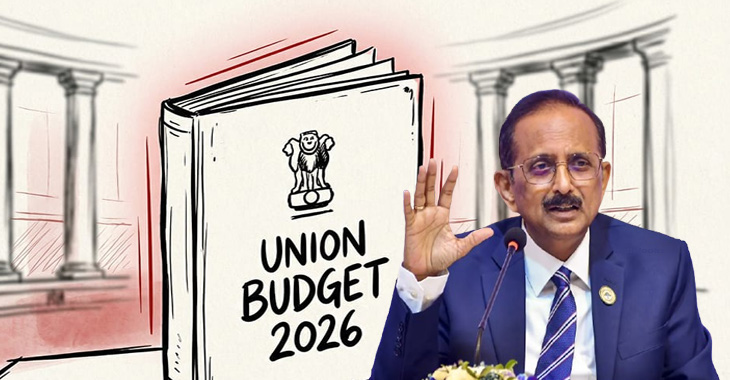
Challa Sreenivasulu Setty stated that, Chairman of the State Bank of India, the Budget for 2026–2027 is a major step toward turning India into a global center for innovation and sophisticated manufacturing with global competitiveness as the cornerstone.
The budget attempts to strike a delicate balance between the rural and urban, legacy and sunrise industries while maintaining policy continuity and tax predictability.The budget for this year includes both futuristic and predictable components.
The predictable portion is the basic framework which remains focused on emerging and employment creating sectors.
“With an increase in proposed investments, the infrastructure sector continues to be an anchor,” he stated in the “Union Budget 2026-27 Analysis Report” published by State Bank of India.
The banking industry has a lot of advantages and prospects. Reinventing banking in quickly changing context and maintaining financial markets orderly and stable, thereby aligning with India’s next phase of growth continues to be crucial for the sector, Setty added.
Announcements on semiconductors, data centers, carbon capture utilization and storage, critical minerals, and other areas are part of the futurist push on sunrise industries.
“Starting with basic fiscal math, the budgetary allocations are based on the assumption of nominal GDP growth of 10 per cent which appears prudent given the way inflation is panning out.
According to him, this results in a budget imbalance of 4.3 percent of GDP.
The Budget has made some significant changes in the areas of agriculture and rural areas.
“The focus will now be on high value products such as sandalwood, cashews, fisheries though Integrated development of 500 reservoirs, coconut promotion scheme to increase production, rejuvenating old, low-yielding orchards and expand high-density cultivation of walnuts, almonds and pine nuts,” said the SBI Chairman.
There is additional attention on growing the use of AI in agriculture by integrating Agri Stack portals.
A focus on services, especially tourism, the orange economy, and education, is appropriate and complementary to the planned infrastructure expansion, connectivity, and future growth driven by digital capital expenditures.
As a key component of Viksit Bharat, the services sector will be the focus of the High-Powered “Education to Employment and Enterprise” Standing Committee.
The enormous scope of specialized building necessitates a local infrastructure equipment supply chain. In light of this, the budget suggests producing high-value, cutting-edge infrastructure and construction equipment domestically.
Setty stated, “On the financing side, an Infrastructure Risk Guarantee Fund will be established to provide prudently calibrated partial credit guarantees to lenders in order to further strengthen the confidence of private developers.”
The Budget has attempted to leverage the potential of urban agglomerations in recognition of India’s fast urbanization. In order to do this, city economic regions (CER) would be mapped according to their unique growth drivers, and each CER will get a five-year allocation of Rs 5,000 crore for the implementation of development plans.
According to Setty, the Budget has suggested expanding the present Indian Semiconductor Mission (ISM) in the sunrise industries by proposing India Semiconductor Mission (ISM) 2.0 to manufacture materials and equipment, create full-stack Indian intellectual property, and strengthen supply chains.
Keeping in mind the disruption in vital minerals, the existing National vital Mineral Mission will be complimented by a dedicated Rare Earth Corridors to be constructed and exemption from BCD for capital goods import.
The people oriented efforts, ease of doing business and living metrics which create the softer side of the tough decisions highlights the challenges that country faces, he observed.