
How to Start Your IT Career After Graduation: A Complete Guide
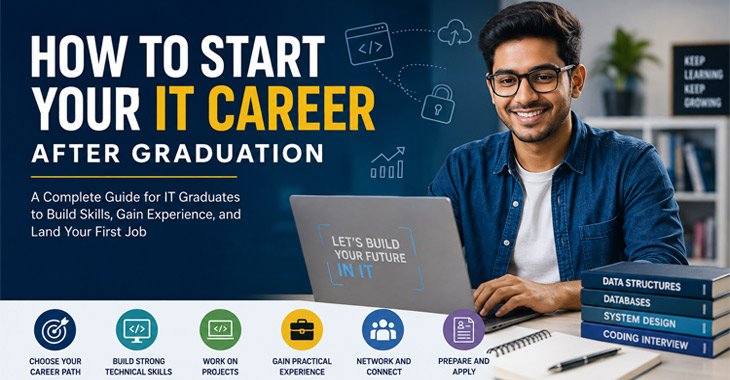
Earning a degree in Information Technology is an important milestone, but it is only the beginning of a professional journey.
The IT industry offers opportunities across software development, cybersecurity, cloud computing, data analytics, artificial intelligence, IT infrastructure, product management, quality assurance, and many other emerging fields.
However, having a degree alone does not automatically guarantee a successful career. Graduates need to understand the industry, identify their strengths, build practical skills, gain experience, and continuously adapt to changing technologies.
For students and fresh graduates, the transition from college to the professional world can often feel confusing. Questions such as “Which IT career should I choose?”, “Do I need certifications?”, “How can I get my first job without experience?”, and “Should I learn programming?” are common.
The good news is that the IT sector provides multiple entry points, and there is no single career path that every graduate must follow.
The key is to approach the first few years strategically. Instead of trying to learn every technology available, graduates should develop a strong foundation, choose a suitable specialization, create evidence of their skills, and actively pursue opportunities.
Understanding the IT Career Landscape
The first step after completing an IT degree is to understand the wide range of career options available. Information Technology is not limited to software programming. Companies need professionals who can develop applications, manage infrastructure, protect information, analyze data, automate processes, support customers, manage technology products, and implement digital transformation initiatives.
Some of the major career paths include:
- Software and application development
- Web and mobile development
- Data analytics and data science
- Artificial intelligence and machine learning
- Cybersecurity
- Cloud computing
- DevOps and site reliability engineering
- Database administration
- IT support and infrastructure
- Quality assurance and software testing
- UI/UX and product design
- Business analysis
- IT project management
- Enterprise technology consulting
- Technical sales and solutions engineering
This variety is an advantage for graduates. Someone who does not enjoy programming all day can still build an excellent IT career in cybersecurity, business analysis, cloud operations, testing, consulting, project management, or other technology-related functions.
Start by Identifying Your Career Direction
One of the biggest mistakes graduates make is trying to follow whatever technology is currently popular. A technology may be in demand, but that does not necessarily mean it is the right career choice for everyone.
Before selecting a specialization, consider three factors: interest, aptitude, and market demand.
If you enjoy solving logical problems and writing code, software development may be suitable. If you are interested in numbers, patterns, and business decisions, data analytics could be a strong option. If you are curious about digital threats and security, cybersecurity may be attractive. Those who enjoy infrastructure and automation can explore cloud computing and DevOps.
Students should also consider whether they prefer technical or business-oriented roles. IT professionals increasingly work between technology and business teams. Business analysts, technology consultants, product managers, and project managers, for example, need technical understanding without necessarily being full-time programmers.
Choosing an initial direction does not mean making a permanent decision. IT professionals frequently change specializations as their careers develop.
Strengthen Your Technical Foundation
After choosing a broad direction, graduates should strengthen their fundamentals.
For software development, this may include programming concepts, data structures, algorithms, databases, version control, APIs, software development methodologies, and application architecture.
For data-related careers, graduates should understand statistics, databases, SQL, data visualization, spreadsheets, programming fundamentals, and data analysis concepts.
For cybersecurity, the foundation can include networking, operating systems, authentication, security principles, vulnerabilities, risk management, and security monitoring.
For cloud careers, graduates should understand networking, operating systems, virtualization, storage, databases, security, and basic cloud architecture.
Strong fundamentals are particularly important because technologies change rapidly. A graduate who only memorizes a particular software tool may struggle when that tool changes. Someone with a solid understanding of underlying concepts can learn new technologies much more quickly.
Do Not Depend Only on Your Degree
A degree demonstrates that you have completed formal education, but employers increasingly want evidence that candidates can apply what they have learned.
This is where projects become extremely valuable.
Instead of simply listing programming languages or technologies on a résumé, graduates should build practical projects that demonstrate those skills. A software development graduate could create a task management application, e-commerce prototype, employee management system, or mobile application. A data analytics candidate could analyze publicly available datasets and create meaningful dashboards. A cybersecurity aspirant could develop a home lab to understand security monitoring and network protection.
Projects do not have to be revolutionary. They need to demonstrate problem-solving ability, technical knowledge, documentation, and the ability to complete something from beginning to end.
A well-documented project can become an important talking point during interviews.
Build a Professional Portfolio

A portfolio gives employers something tangible to evaluate.
Graduates should consider maintaining a professional Git repository or personal portfolio website where they can showcase selected projects. Each project should explain the problem being addressed, technologies used, the candidate’s contribution, and the outcome.
For example, instead of writing:
“Python, SQL, Power BI.”
A graduate could demonstrate:
“Built a sales analytics dashboard using SQL and Power BI to identify monthly revenue trends, regional performance, and top-performing product categories.”
The second statement provides evidence of application rather than simply listing tools.
A portfolio can also include technical articles, project documentation, certifications, presentations, case studies, and contributions to open-source projects.
Gain Experience Before You Get Your First Full-Time Job
One of the most frustrating aspects of starting an IT career is the requirement for experience in entry-level job advertisements. Graduates often wonder how they can obtain experience when nobody is willing to hire them.
The answer is to create multiple forms of experience.
Internships are one of the strongest options. Even a short internship can expose graduates to professional workflows, teamwork, deadlines, code reviews, documentation, and client requirements.
Freelance projects can also provide practical experience. Students can work on websites, dashboards, automation scripts, testing assignments, or other small technology projects.
Open-source contributions provide another opportunity. Contributing documentation, fixing bugs, improving code, or participating in community projects can demonstrate collaboration and technical ability.
Academic projects should also be treated seriously. Instead of completing a final-year project only to obtain marks, graduates can develop it into a portfolio project.
Learn How to Use AI as a Career Accelerator
Artificial intelligence is changing how IT professionals work. For new graduates, understanding AI tools can become an important professional advantage.
However, using AI should not replace foundational knowledge. Graduates should learn how to use AI for research, coding assistance, debugging, documentation, testing, data analysis, brainstorming, and productivity while retaining the ability to evaluate its output.
For example, a software developer may use AI-assisted tools to generate initial code but should understand why the code works and how to test it. A data analyst may use AI to explore a dataset but should still validate calculations and conclusions.
AI literacy is becoming relevant across many IT roles, not only artificial intelligence jobs. Professionals who understand both technology fundamentals and responsible AI usage can potentially become more productive and adaptable.
Develop Communication Skills Alongside Technical Skills
Technical knowledge can help a graduate obtain an interview, but communication skills can significantly influence career growth.
IT professionals rarely work alone. Developers communicate with designers, testers, managers, business teams, customers, and other developers. Data analysts need to explain findings to non-technical stakeholders. Cybersecurity professionals must communicate risks to management. Consultants need to understand client requirements and present recommendations clearly.
Graduates should therefore practice explaining technical concepts in simple language.
A useful exercise is to take a technical project and explain it in three ways: to another IT professional, to a manager, and to someone with no technical background.
This develops the ability to adapt communication to the audience.
Prepare a Strong IT Résumé
A résumé is often the first professional document an employer sees. Fresh graduates should keep it focused and relevant.
A strong entry-level IT résumé can include:
Professional summary
Technical skills
Education
Projects
Internship or work experience
Certifications
Achievements
Relevant extracurricular activities
Graduates should avoid filling the résumé with every technology they have ever encountered. Listing 30 technologies without demonstrating proficiency can weaken credibility.
Instead, prioritize skills relevant to the target position.
For example, someone applying for a junior data analyst role should emphasize SQL, Excel, Python, data visualization, statistics, analytical projects, and relevant internships rather than unrelated programming languages.
Optimize Your Professional Online Presence
Recruiters increasingly use professional networking platforms to identify candidates. Graduates should therefore create a professional online profile rather than treating social networking as purely personal.
The profile should contain a clear headline, professional summary, education, skills, projects, certifications, and relevant experience.
Students can also share useful content related to their field. They could write about a project they completed, explain a technology they learned, discuss an industry trend, or share lessons from an internship.
The objective is not to become an influencer. It is to demonstrate genuine interest in the profession and make it easier for recruiters and industry professionals to understand the candidate’s capabilities.
Build a Professional Network
Networking is another important part of beginning an IT career.
Graduates should connect with alumni, former classmates, professors, recruiters, developers, consultants, technology leaders, and professionals working in their areas of interest.
Networking should not simply mean asking everyone for a job. Instead, graduates can ask professionals about their career journeys, technologies they recommend learning, entry-level opportunities, and industry expectations.
Technology conferences, webinars, hackathons, developer communities, workshops, college alumni groups, and professional networking platforms can all provide opportunities to build relationships.
A strong professional network can eventually lead to referrals, internships, mentorship opportunities, and job interviews.
Consider Certifications Strategically
Certifications can strengthen a graduate’s profile, particularly in specialized areas such as cloud computing, cybersecurity, networking, databases, and enterprise technologies.
However, collecting certifications without practical knowledge is not a strong career strategy.
A certification should support a career direction. For example, someone pursuing cloud computing could consider an entry-level cloud certification after learning the fundamentals of networking, storage, compute, identity, and cloud architecture.
Similarly, cybersecurity candidates can explore certifications aligned with foundational security knowledge.
The goal should be to combine certification with hands-on practice.
Apply for the Right Entry-Level Roles
Graduates should not restrict their job search to one exact job title.
For example, a graduate interested in cybersecurity could explore roles such as security analyst trainee, SOC analyst, security operations intern, IT support associate, or junior security administrator.
A software development aspirant could look for junior developer, software engineer trainee, application developer, backend developer, frontend developer, or QA automation roles.
This broader approach increases the number of relevant opportunities without abandoning the long-term career objective.
Graduates should also distinguish between jobs that genuinely provide technology exposure and positions that use IT terminology but offer limited professional development.
Prepare Seriously for Technical Interviews
Getting an interview is only the first step. Candidates must prepare for technical and behavioral discussions.
Technical preparation should be aligned with the role. Software developers may encounter questions about programming, data structures, algorithms, databases, APIs, and system fundamentals. Data roles may involve SQL, statistics, analytical reasoning, and visualization. Infrastructure positions may test networking, operating systems, cloud concepts, and troubleshooting.
Candidates should also prepare to discuss every project listed on their résumé.
A common mistake is adding a project to the résumé and then being unable to explain it. Interviewers may ask why a particular technology was selected, what challenges occurred, how the system was tested, and what the candidate would improve.
Graduates should be prepared to answer these questions honestly.
Do Not Ignore Soft Skills and Workplace Behavior
A successful IT career involves more than technical competence.
Employers value reliability, teamwork, accountability, adaptability, curiosity, time management, and willingness to learn.
A graduate who accepts feedback and improves consistently can become more valuable than someone who possesses more technical knowledge but refuses to collaborate.
Professional behavior begins from the first internship or entry-level position. Meeting deadlines, documenting work, asking thoughtful questions, participating in meetings, and communicating problems early can make a significant difference.
Choose Your First Job for Learning, Not Only Salary
Salary is naturally important, but fresh graduates should evaluate their first job using multiple factors.
Ask:
Will I work with modern technologies?
Will I receive mentorship?
Will I work on real projects?
Is there structured training?
Can I learn from experienced professionals?
Will I have opportunities to take responsibility?
Does the company provide career development opportunities?
Is the role aligned with my long-term goals?
A slightly lower starting salary may sometimes provide significantly better learning opportunities. Strong skills developed during the first few years can create opportunities for better compensation later.
That does not mean graduates should accept unfair compensation or poor working conditions. It means the first job should be evaluated as the beginning of a professional trajectory rather than only as a monthly paycheck.
Keep Learning After Getting the Job
Getting the first IT job is not the end of the learning journey. It is the beginning.
Technology evolves continuously. Programming frameworks change, cloud platforms expand, cybersecurity threats become more sophisticated, and AI is transforming workflows across organizations.
Professionals should therefore establish a sustainable learning routine.
This could involve spending several hours each week learning a new technology, reading technical documentation, taking a structured course, working on a side project, attending professional events, or discussing emerging technologies with colleagues.
The objective should not be to chase every trend. Instead, professionals should understand which developments are relevant to their role and industry.
Develop a Five-Year Career Perspective
Fresh graduates often focus entirely on getting their first job. It is useful to think further ahead.
Ask where you would like your career to be after three to five years.
You may want to become a senior software engineer, cloud architect, cybersecurity specialist, data scientist, technology consultant, engineering manager, product manager, or entrepreneur.
The answer can change over time, but having a general direction helps determine which skills and experiences to pursue.
For example, someone who eventually wants to become an engineering manager should develop not only technical expertise but also communication, mentoring, project planning, and leadership capabilities.
Someone who wants to become a technology consultant should develop business understanding, presentation skills, problem-solving capabilities, industry knowledge, and client-facing experience.
Common Mistakes IT Graduates Should Avoid
Several mistakes can slow down the beginning of an IT career.
The first is trying to learn everything. The IT industry is too broad for anyone to master every technology. Choose a direction and develop depth before expanding.
The second is relying entirely on certificates. Certifications are useful, but practical projects and problem-solving skills matter greatly.
The third is ignoring communication. Technical professionals need to communicate with people.
The fourth is copying projects without understanding them. Interviewers can usually identify when candidates cannot explain their own work.
The fifth is refusing entry-level opportunities because they do not perfectly match a dream job. The first position should ideally provide relevant experience and a path for growth.
The sixth is stopping education after getting a job. Continuous learning is one of the defining characteristics of a successful technology career.
A Practical Roadmap for Fresh IT Graduates
A graduate can approach the first year using a structured roadmap.
Months 1–2: Choose a Direction
Identify two or three potential career paths and research the skills required for each. Select one primary direction based on interest, aptitude, and job demand.
Months 2–4: Build Fundamentals
Study the core concepts associated with the selected field. Avoid jumping immediately between unrelated technologies.
Months 4–6: Build Projects
Create two or three meaningful projects. Document them properly and publish appropriate work through a professional portfolio or repository.
Months 5–7: Improve Your Résumé and Profile
Build a focused résumé and professional online profile. Highlight projects, internships, skills, certifications, and measurable achievements.
Months 6–9: Gain Practical Exposure
Apply for internships, apprenticeships, freelance assignments, open-source opportunities, hackathons, and entry-level roles.
Months 7–12: Apply and Interview
Apply consistently while preparing for technical and behavioral interviews. Track applications and learn from rejection rather than treating it as failure.
Beyond Year One: Specialize
Once you have workplace experience, identify a specialization and develop deeper expertise. Consider certifications, advanced projects, mentorship, and leadership opportunities based on your career goals.
The Future Belongs to Adaptable IT Professionals
The IT industry will continue to change. Artificial intelligence, cloud computing, cybersecurity, automation, data platforms, software engineering, digital transformation, and emerging technologies will continue creating new opportunities while changing existing roles.
For graduates, this means adaptability may be as important as technical knowledge.
The strongest professionals will not necessarily be those who know every new tool first. They will be those who understand fundamentals, learn quickly, solve real problems, communicate effectively, and understand how technology creates business value.
A degree provides the foundation. Skills create capability. Projects demonstrate those skills. Experience builds professional credibility. Networking creates opportunities. Continuous learning sustains long-term career growth.
Conclusion
Starting a career after earning an IT degree can seem challenging, but graduates have more opportunities today than ever before. The IT sector offers diverse career paths, from software engineering and cybersecurity to data analytics, cloud computing, consulting, AI, testing, infrastructure, and technology management.
The most effective approach is to avoid waiting for the “perfect” opportunity. Choose a direction, strengthen your fundamentals, build practical projects, gain experience, create a professional presence, develop communication skills, network with industry professionals, and apply consistently.
Most importantly, remember that the first job does not define the entire career. It is a starting point.
A successful IT career is built gradually through learning, experimentation, professional relationships, real-world experience, and the willingness to adapt. Graduates who combine technical competence with curiosity, communication, and a problem-solving mindset can build careers that remain relevant even as technology continues to evolve.
The degree opens the door. What you learn, build, and accomplish after graduation determines how far you can go.