
Jagdeep Dhankhar resigns as Vice President of India
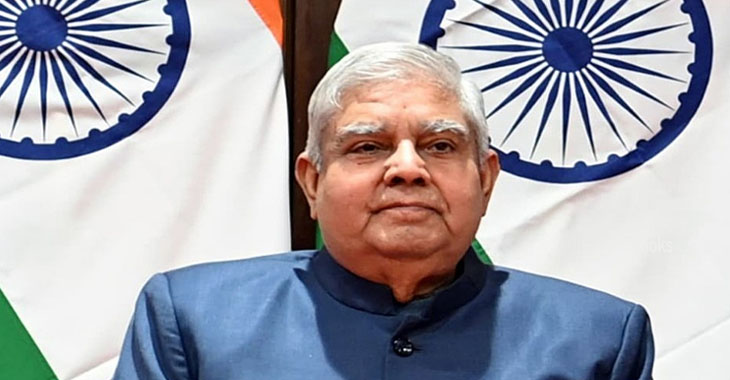
On Monday, India’s 14th vice president, Jagdeep Dhankhar, submitted his resignation to President Droupadi Murmu, citing health concerns. He has two years left in his position until he resigns.
He cited Article 67(a) of the Indian Constitution, which allows for the vice president’s resignation, in his letter.
Experts predict that the resignation of Jagdeep Dhankhar will now initiate the constitutional procedure for choosing a new Indian vice president. Experts stated that the position cannot be unfilled for very long because the vice president also holds the position of chairman of the Rajya Sabha.
Despite its brief duration, his tenure was distinguished by his keen legal understanding and strong mastery of legislative procedures. During his public life, he was actively involved in national concerns.
The tale of Dhankhar’s ascent from a small Rajasthani village to one of India’s most important constitutional positions is one of tenacity, adaptability, and public duty. He has been in the public eye for more than forty years.
Jagdeep Dhankhar was born on May 18, 1951, in Kithana, a tiny village in Rajasthan’s Jhunjhunu district. He comes from a humble agricultural family. The BJP then emphasized his status as a “Kisan Putra” (farmer’s son) in its political rhetoric when he was nominated for vice president.
He finished his education at Sainik School in Chittorgarh, which is renowned for turning out a number of prominent public servants and members of the armed forces. After earning a Bachelor of Science degree from the University of Rajasthan in Jaipur, he continued his education there to earn his LLB.
Dhankhar registered with the Rajasthan Bar Council and started practicing law in 1979. He quickly gained a reputation as a strong legal intellect. He became one of the most well-known attorneys in the state after the Rajasthan High Court named him a Senior Advocate in 1990.
He practiced in several high courts as well as the Supreme Court of India, where he handled a range of constitutional and civil disputes. The Rajasthan High Court Bar Association elected Dhankhar as its president. His reputation in the legal community was further solidified by this position.
After obtaining a seat in the Lok Sabha from Jhunjhunu, he entered politics in 1989. On a Janata Dal ticket, this victory was achieved. He soon became a minister as a result of his persuasive parliamentary lobbying. In 1990, he was named Minister of State for Parliamentary Affairs under Prime Minister Chandra Shekhar. He was in charge of crucial government-legislative coordination.
Later, from 1993 to 1998, he represented the Kishangarh constituency as a member of the Rajasthan Legislative Assembly.
In addition to his role as Vice President, Dhankhar presided over important legislative discussions as the Rajya Sabha’s ex-officio Chairman.
Discussions regarding the function of the vice presidency in modern-day India will continue to be influenced by Dhankhar’s legacy as a constitutional authority, legal luminary, and supporter of democratic processes even after he stands down.