
India’s textile industry is a strong economic engine that creates jobs
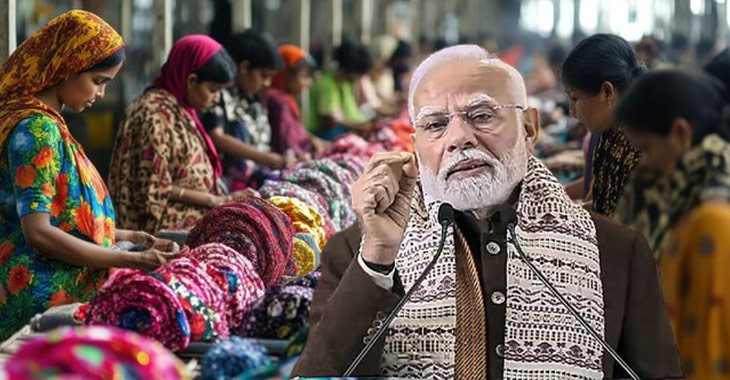
Prime Minister Narendra Modi emphasized how India’s textile industry has evolved from a legacy sector to a potent, people-focused growth engine that embodies the genuine essence of Aatmanirbhar Bharat.
PM Modi cited an article by Union Minister Giriraj Singh that highlights the significance of new free trade agreements and the Center’s PLI programs, which are generating the next generation of jobs.
Strong local demand and growing consumption are the main drivers of India’s textile revival. India, home to more than 140 crore people, is one of the most robust textile markets in the world. According to the minister, the domestic textile market increased from approximately Rs 8.4 lakh crore to an anticipated Rs 13 lakh crore in just five years.
He added that per capita textile consumption has nearly twice over the last ten years, from over Rs 3,000 in 2014–15 to over Rs 6,000 in 2024–25, and is expected to double once again to Rs 12,000 by 2030.
This expansion driven by demand has been reflected in exports. Exports of textiles and clothing increased by almost 28% in the post-Covid era, from Rs 2.49 lakh crore in 2019–20, the year COVID hit, to over Rs 3.5 lakh crore in 2024–2025.
The Minister continued, “This dramatic comeback highlights India’s capacity to swiftly scale manufacturing as global demand returns and, crucially, to convert export growth into employment across the textile value chain.”
Additionally, the minister emphasized the significance of the PM MITRA Park initiative. Under this initiative, which aims to increase production, employment, and exports, the government anticipates investments in the textiles sector totaling Rs. 18,500 crore.
The government has approved the establishment of seven PM Mega Integrated Textile Region and Apparel (PM MITRA) Parks in greenfield and brownfield sites with an outlay of Rs. 4,445 crore for the period 2021–2022 to 2027–2028 in order to develop integrated large-scale and modern industrial infrastructure facilities for the entire value-chain of the textile industry.
Seven locations have been selected by the government to establish PM MITRA Parks: Tamil Nadu (Virudhnagar), Telangana (Warangal), Gujarat (Navsari), Karnataka (Kalaburagi), Madhya Pradesh (Dhar), Uttar Pradesh (Lucknow), and Maharashtra (Amravati).
Each PM MITRA Park is anticipated to bring in roughly Rs. 10,000 crore in investment and create over 3 lakh direct and indirect job opportunities after it is finished.