
Govt will prioritize reducing the debt-to-GDP ratio in the upcoming fiscal
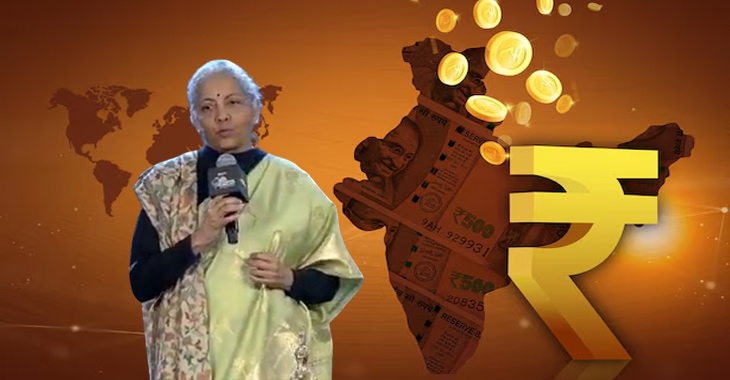
Finance Minister Nirmala Sitharaman announced on Wednesday that the government’s primary objective for the upcoming financial year (2026-27) will be to lower the country’s debt-to-GDP ratio.
While addressing a media gathering, Sitharaman emphasized the importance of reducing the debt-to-GDP ratio, which exceeded 60 percent during the Covid years.
“It is already declining, but we need to continue to lessen it, and this will be a major emphasis in the next financial year,” the Finance Minister stated, pointing out that Reserve Bank of India reports indicate concerning debt-to-GDP ratios in certain states.
“Unless we manage within the Fiscal Responsibility and Budget Management Act (FRBM) limits and reduce high-interest debt, states will borrow to pay off loans rather than for development, which is a poor fiscal strategy. This endangers the 10-year momentum for Viksit Bharat by 2047,” she emphasized.
The Finance Minister noted that the Central government has established targets for transparency in budgeting, aiming to ensure that fiscal management aligns with accountability standards.
“We’ve lowered the debt-to-GDP ratio from over 60 percent after Covid; it’s decreasing, with debt reduction being a central aim for the next financial year (the fiscal deficit remains a key indicator). Entrepreneurs in banking note the evolving ecosystem,” she remarked.
Sitharaman mentioned that the government is also focused on enhancing the bond market to facilitate increased funding.
The discipline demonstrated by the Union government under Prime Minister Narendra Modi‘s consistent leadership—now in its third term—enhances India’s ability to negotiate globally. This strength comes from a stable government, she remarked.
Sitharaman further indicated that through financial inclusion, access to credit via Mudra, and widespread bank accounts, the credit profiles of all Indians have expanded, allowing for formal bank credit.
“I assert this because we can aspire to an India contributing 25 percent to global trade—25 percent of global trade should originate from India. This is the benchmark for Viksit Bharat: rejuvenate manufacturing, agriculture, value addition, and the services sector (which has grown to over 60 percent of GDP on its own, with minimal government intervention—not only IT, but also tourism and hospitality),” the Finance Minister stated.
She acknowledged that private sector research and development contributes value.
“The Opposition has raised accusations and claims that despite corporate tax reductions in 2019, capacity is not expanding and that corporations are profiting without investing. That critique is unwarranted. The reduction was essential, and businesses must grow within the nation. Prime Minister Modi supports corporations to create jobs and boost GDP. There are questions regarding why they aren’t investing more, which is acceptable as it is ultimately their decision. GCCs and data centers create jobs, necessitating energy security—thus the approval of the nuclear bill, alongside the adoption of small modular reactors as clean energy options along with pumped storage, hydro, solar, and wind,” Sitharaman observed.
“Navigating geoeconomics represents a significant opportunity for steady growth, maintaining this level each year—something that the people of India are accomplishing. Each of us, including all political entities and critics, should acknowledge this, as credit is due to the people of India. Contrary to many predictions, whether during Covid or not, the populace did not remain passive; the resilience of India is a narrative that we must all support and facilitate for decades to come.”
The Finance Minister expressed concern that “globally, trade is neither fair nor free. India endures criticism for being introspective or a ‘tariff king’, yet tariffs are weaponized—India defends itself against dumping, while others do not face scrutiny.”
“This is the new reality; India must negotiate prudently by leveraging its economic strength,” she concluded.