
India’s Economic Reforms Pave the Way for Enterprise-Led Growth
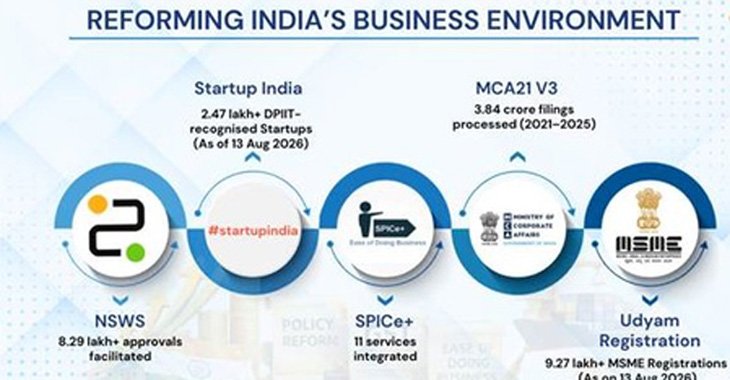
As India prepares to celebrate its 80th Independence Day, the country continues to strengthen the foundations of a self-reliant, resilient and growing economy.
The Union government is advancing Ease of Doing Business through digital single-window systems, simpler business incorporation, wider market access, better access to finance and trust-based regulation, according to an official factsheet issued on Thursday.
The National Single Window System (NSWS) now helps businesses identify and apply for approvals based on their specific requirements. The digital platform integrates approvals from 32 Union Ministries and 34 states, providing access to more than 686 Central and 7,498 state-level approvals.
Since its launch in 2021, NSWS has facilitated more than 8.29 lakh approvals, helping businesses reduce administrative hurdles and navigate regulatory requirements more efficiently.
Startup India Expands India’s Entrepreneurial Base
The Startup India initiative continues to support entrepreneurs and strengthen the country’s startup ecosystem. The programme aims to transform India into a nation of job creators rather than job seekers.
According to the factsheet, DPIIT-recognised startups increased from 502 in 2016 to more than 2.47 lakh as of August 12, highlighting the rapid expansion of India’s entrepreneurial ecosystem.
The government has also simplified company incorporation through the SPICe+ web-based form, which integrates multiple services across three Central government Ministries and departments.
The form combines essential procedures such as name reservation, company incorporation, Director Identification Number (DIN) allotment, PAN and TAN issuance, EPFO and ESIC registration, Profession Tax registration, bank account opening and GSTIN allotment. It also enables first-time registration of shops and establishments for new companies incorporated in Delhi.
By bringing these processes together, SPICe+ reduces procedural complexity, saves time and lowers compliance costs for businesses.
Digital Corporate Services Improve Transparency
The MCA21 Project is further strengthening India’s corporate regulatory infrastructure through digital and AI-driven services. The platform provides end-to-end registry and incorporation services for companies and limited liability partnerships (LLPs).
Between 2021 and 2025, MCA21 processed 3.84 crore filings, with 3.33 crore filings approved through the Straight Through Process, according to the government factsheet.
For MSMEs, the Udyam Registration platform provides a free, paperless and self-declaration-based registration system. MSME registrations on the Udyam Portal increased from 0.1 lakh in October 2020 to more than 9.27 lakh by August 13, reflecting wider formalisation among small businesses.
States Push Business Reforms
The Business Reform Action Plan (BRAP), launched in 2015, continues to encourage states and Union Territories to simplify regulations and improve transparency.
The programme covers reforms related to single-window clearances, land, labour, inspections, taxation and environmental approvals, among other areas. These reforms aim to create a more predictable business environment and encourage enterprises to invest and expand.
Easier Credit Supports MSME Growth
The government is also expanding formal financing options through credit guarantees, digital lending and receivables financing, particularly for MSMEs.
The Pradhan Mantri MUDRA Yojana (PMMY) provides collateral-free loans of up to Rs 20 lakh for non-corporate and non-farm income-generating activities. As of March 27, 2026, the scheme had sanctioned Rs 40.07 lakh crore through 57.79 crore loans since its inception.
The Credit Guarantee Scheme also enables micro and small enterprises to access credit without collateral security or third-party guarantees, supporting credit facilities of up to Rs 10 crore.
As of March 2026, the Credit Guarantee Fund Trust for Micro and Small Enterprises (CGTMSE) had approved cumulative credit guarantee coverage of Rs 13.67 lakh crore, benefiting 1.41 crore guarantees, the factsheet said.
Together, these reforms are helping India build a more digital, formal and accessible business ecosystem.
By reducing regulatory friction, expanding financing opportunities and supporting startups and MSMEs, the government is creating stronger conditions for enterprise-led economic growth and greater private-sector participation.