India can maintain J-curve benefits with consistent FDI and trade diversion
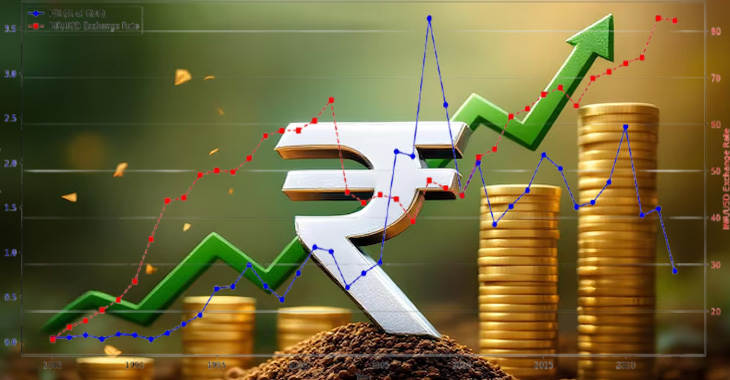
India can retain “J‑curve” advantages despite rupee weakness, if trade diversion becomes ingrained in durable supply chains and is supported by logistics efficiency, a research stated on Friday.
In order to maintain the J-curve gains, the Emkay Global Financial Services study also emphasized limited tariffs on capital goods and intermediaries as well as consistent long-term FDI, stressing that these elements will be significantly more important in the medium run than tariffs.
It predicted that the 10-year government bond yield would end FY26 and FY27 at roughly 6.50% and 6.25%, respectively, with a current account deficit of 1.3% of GDP for FY27 and USD/INR trading in an 87–95 range.
According to the business, the Union Budget for FY27 will follow the same course of “calibrated fiscal consolidation, with the government shifting its fiscal anchor to debt-to-GDP.”
It was anticipated that the “Budget 2026” will seek to maintain India’s medium-term economic stability while striking a careful balance between fiscal discipline, growth support, and reform continuity.
According to the research, the RBI will be the bond demand-supply balancing element for improved monetary transmission, particularly as FY27 is expected to witness a $15 billion balance of payments deficit for the third time in a row.
According to the research, open market operations are expected to be valued over Rs 5 trillion in FY27.
“While RBI’s sizable unsterilised FX intervention in recent months has drained liquidity, past build-up of a heavy net dollar short position” is dragging both on foreign‑exchange and fixed‑income markets, the paper added.
It expected additional primary liquidity injections of around Rs 1.5 trillion throughout the rest of FY26.
According to the research, the government is expected to aim for a gross fiscal deficit of 4.3% of GDP, capital spending of about 3% of GDP, and gross tax budgeted growth of 8.2%.
“Fiscal consolidation is anticipated to continue at a moderate pace, even though the economic environment is still difficult. The government’s intention to prioritize medium-term debt sustainability without sacrificing growth is shown by the change towards debt-to-GDP as the anchor, according to Madhavi Arora, Chief Economist at Emkay Global Financial Services.