

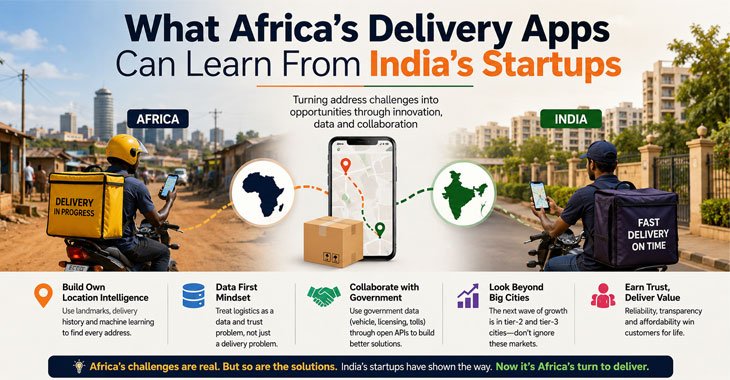

Africa’s home delivery apps face a major challenge: many cities lack reliable addressing systems, making it difficult for companies to deliver packages quickly and accurately to consumers.
A report says African startups can learn from Indian companies that tackled similar challenges by using technology, location intelligence and data-driven logistics.
“Nairobi’s estates and Lagos’s informal settlements were never built with postal codes in mind, and they are not going to get them soon,” a report stated.
The article noted that companies in other emerging markets faced similar challenges and developed practical solutions using landmarks, delivery histories and machine learning. These tools helped companies identify locations with increasing accuracy and reduced failed deliveries.
The challenge does not uniquely affect Africa. India faced similar logistics difficulties about a decade ago, with fragmented courier networks and addresses that often relied on local knowledge rather than standardised data. People frequently described locations using landmarks and directions such as a particular gate, building or road turn.
Indian startups tackled the problem by shifting their approach. Instead of treating logistics solely as a trucks-and-warehouses challenge, they focused on data, location intelligence and customer trust.
The article suggests that Kenyan and Nigerian entrepreneurs and policymakers can study this approach as they develop their own delivery ecosystems.
Rather than waiting for governments to create comprehensive addressing systems, logistics startups can develop their own location intelligence platforms. These systems can learn from successful and failed deliveries and continuously improve their ability to identify a consumer’s exact location.
The article also highlights the importance of cooperation between governments and private businesses.
“One structural choice is worth borrowing directly: treat government as an infrastructure provider, not a rival to private business,” the article observed.
Governments can make existing public data, including vehicle registration, licensing, toll and customs information, accessible through digital interfaces. Startups can then use this infrastructure to develop practical logistics and delivery solutions.
The report also urges African startups to look beyond national capitals. In several emerging markets, significant growth has come from second- and third-tier cities rather than the largest urban centres.
For African delivery platforms, expanding into these underserved markets could create new opportunities while encouraging companies to develop affordable and adaptable delivery models suited to local conditions.
India’s experience demonstrates that weak addressing infrastructure does not have to permanently restrict e-commerce and doorstep delivery.
With location intelligence, machine learning, reliable delivery data and stronger public-private collaboration, African startups can build systems that work around existing infrastructure gaps and bring faster deliveries to more consumers.