


When Prime Minister Narendra Modi launched the BHIM UPI App during the “DigiDhanMela” inauguration on December 31, 2016, he urged citizens to adopt digital payments and turn India into a cashless economy.
On Tuesday, he recalled this decade-long journey, marking a major turning point in India’s payment landscape. Highlighting its massive scale, PM Modi posted on X that every Indian could feel proud of UPI’s success. He invited citizens to share how the platform changed their daily lives.
Digital payments have reshaped how citizens transact, positioning India as a global leader in digital finance. A platform that began modestly now forms the backbone of the nation’s financial system—achieving, as the Prime Minister noted in another post, “nearly a 13,000-fold rise in transaction value.”
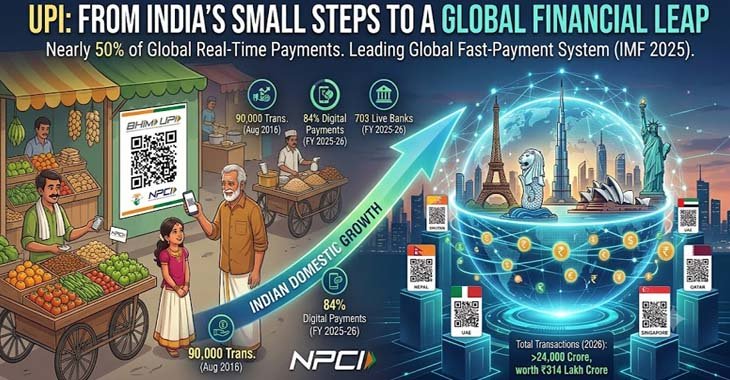
During its inaugural month in August 2016, UPI processed around 90,000 transactions. By FY 2025–26, it handled 84 percent of all digital payments in India.
Simultaneously, the platform expanded its live network from 44 banks in FY 2016–17 to 703 banks in FY 2025–26, integrating public, private, small finance, and cooperative institutions.
The National Payments Corporation of India (NPCI) developed UPI, enabling real-time payments through apps like BHIM, PhonePe, Google Pay, and Paytm. The numbers tell a compelling story: UPI processed fewer than 2 crore transactions in its first year, but by 2026, that figure surged past 24,000 crore transactions worth nearly ₹314 lakh crore. The Prime Minister frequently cites these figures, pointing out that UPI now accounts for nearly half of all global real-time digital transactions.
In its June 2025 report, “Growing Retail Digital Payments: The Value of Interoperability,” the International Monetary Fund (IMF) named UPI the largest retail fast-payment system globally by volume. The IMF noted that high interoperability drives this rapid adoption, letting users freely select apps and banks for seamless transfers.
This recognition highlights India’s digital leadership and its shift toward a cashless economy. UPI has sparked a citizen-centric revolution, empowering shoppers, street vendors, farmers, and students to pay digitally with ease.
Beyond domestic borders, international partners accept UPI payments via QR codes to serve Indian tourists, expatriates, and cross-border businesses. Countries including Bhutan, Nepal, France, the UAE, Singapore, Cyprus, and Qatar currently process UPI transactions, while expansions continue across Europe, Southeast Asia, and the Middle East. This footprint project’s India’s ambition to export technology as a form of soft power.
UPI proves India can set global standards rather than simply follow them. The platform opens doors for stronger bilateral trade and expands the nation’s international influence.
Observing this success, institutions worldwide now seek to replicate UPI’s framework. The platform tells a dual story—one of immense numerical scale, and another of national pride and financial inclusion. Over the past decade, India proved its capability to innovate at scale and democratize technology.
As UPI enters its second decade, it serves not just as a payment tool, but as a symbol of India’s digital confidence and technological transformation.