

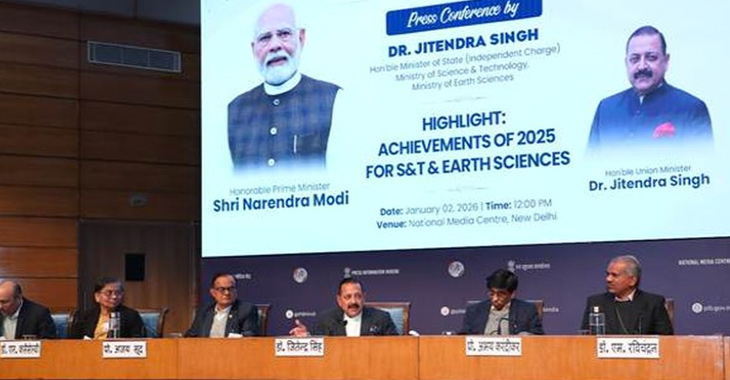

Technology is serving as the driving force behind the transformation in both space and the economy within the country, stated Dr. Jitendra Singh, Union Minister of State (Independent Charge) for Science & Technology, on Friday.
During a press conference discussing the accomplishments of the Ministry of Science and Technology and the Ministry of Earth Sciences for the year 2025, the Minister remarked that innovation-led sectors such as space, oceans, biotechnology, clean energy, and advanced manufacturing will propel India’s growth in the coming two decades.
“India’s reform journey is being propelled by science, technology, and innovation, with technology functioning as the pivotal force in governance, administration, and economic change,” Singh affirmed.
He noted that every significant reform pursued by the government, across various departments and ministries, is facilitated by technology.
“This transformation has been achievable due to the ongoing emphasis on science, technology, and innovation within national policymaking,” the Minister mentioned.
Singh emphasized key missions like the Deep Ocean Mission and Gaganyaan, stating that “India is simultaneously gearing up for human spaceflight and deep-sea exploration.”
He pointed out that while an Indian astronaut will travel to space, India will also deploy a human-occupied submersible capable of reaching depths of 6,000 metres, representing a landmark dual accomplishment in 2027.
He also brought attention to the Research Development and Innovation (RDI) Fund of Rs 1 lakh crore, under which the government is proactively backing R&D efforts in the private sector; and the Anusandhan National Research Foundation (ANRF), which aims to make research funding more accessible.
Singh discussed various initiatives such as the National Quantum Mission, NIDHI, PRERNA / PURSE, and the VAIBHAV programme, which focus on bolstering startups, enhancing research infrastructure, and fostering international scientific collaboration, while actively engaging with the Indian scientific diaspora.
Describing the contributions of CSIR, the Minister referred to globally significant innovations like durable roads made from steel-slag, indigenous production of paracetamol, the first homegrown antibiotic Nafithromycin, and sustainable food innovations featuring millet-based products, along with the HANSA-NG two-seater trainer aircraft developed through a Public-Private Partnership model.
He characterized these initiatives as instances of “foreign markets acknowledging indigenous innovation.” Public engagement programs like One Day as a Scientist were also mentioned for encouraging a scientific mindset among students.
Regarding Earth Sciences, the Minister asserted that India has achieved considerable progress in weather forecasting through the IMD’s Nowcasting capability, which allows for precise predictions over a three-hour span.
He highlighted the desalination plant in Lakshadweep as an exemplary model for sustainable freshwater production utilizing ocean resources, as well as advancements in ocean energy, marine observation systems, and climate resilience.
In closing, Dr. Jitendra Singh stated that India has transitioned from being an importer to an exporter of advanced technologies, including vaccines and medical devices, with the nation’s bioeconomy emerging as a significant driver of growth.
“The best is yet to come,” he said, adding that science-led reforms will hasten India’s ascent to becoming a leading global economy well before 2047.