

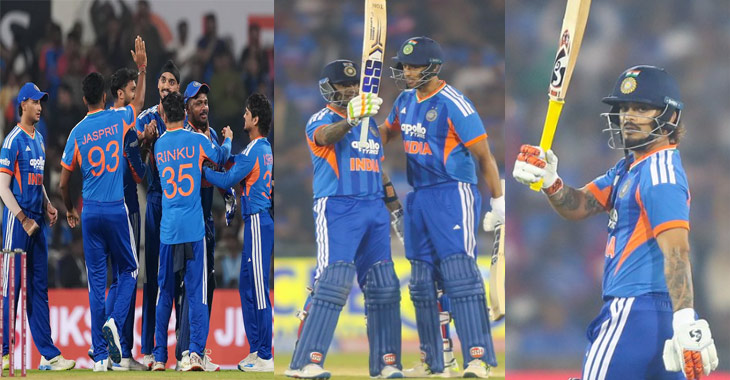

In the second Twenty20 International at the Shaheed Veer Narayan Singh International Stadium in Raipur, India defeated New Zealand by seven wickets with 28 balls left, taking a 2-0 lead in the five-match series. Captain Suryakumar Yadav finally produced a big one, scoring an undefeated 82 while Ishan Kishan contributed a fiery 76.
Additionally, it was India’s second-highest successful chase in T20I history. The Raipur performance surpasses chases of 209/4 against West Indies (Hyderabad, 2019), 209/8 against Australia (Vizag, 2023), and 204/4 against New Zealand (Auckland, 2020), with only India’s 211/4 against Sri Lanka at Mohali in 2009 being higher.
When chasing a target of more than 200, the decisive conclusion was also the largest victory by balls left for a full member nation. It outperformed Australia’s 23-ball triumph over the West Indies in Basseterre in 2025 and Pakistan’s 24-ball victory against New Zealand in Auckland.
India’s answer got off to a shaky start, despite some assistance from the dew. The hosts were suddenly reduced to 6 for 2 when Sanju Samson was dismissed for 6 and Abhishek Sharma made a golden duck. But what came next was an incredible counterattack.
With 122 runs in just 48 balls for the third wicket, Ishan Kishan and Suryakumar Yadav abruptly made what had appeared to be a difficult chase seem effortless.
Early on, Kishan’s aggressiveness caused most of the damage. He scored 76 from 32 balls, including a fifty off 21 balls, when he was removed after mis-hitting Ish Sodhi for a catch off his own bowling. The damage was already done by then.
After laboring on 10 from 10 balls at one point, Suryakumar changed course and started to accelerate. As an added benefit, Shivam Dube was pushed up the order to hit a quickfire 36 (200 SR) and helped Suryakumar clinch the chase with ease by helping the fourth wicket partnership score 81 runs.
Just weeks before a home T20 World Cup, Suryakumar concluded with an outstanding 82 from just 37 balls, reiterating his class and significance to the side.
Earlier, Suryakumar Yadav won the toss and decided to bowl, setting a difficult mark for India. Although both openers had strong starts, they were unable to capitalize on them.
With a strong 44 off 26 balls, Rachin Ravindra took the lead. With an undefeated 47 off 27 balls, captain Mitchell Santner gave the innings a significant push and helped the visitors surpass the 200-run threshold.
By staying unbeaten on 15 off 8, Zak Foulkes also made a contribution. New Zealand’s final score was 208/6.
The bowlers from New Zealand got an opportunity to show their abilities that evening, but their performance was disappointing. The previous record of 63 runs established by Liam McCarthy (Ireland) against the West Indies in Bready in 2025 was broken by Zak Foulkes, who had no luck in his three overs and let up 67 runs, the highest ever for a T20I bowler who is a member of one of the full member teams.
Even though Ish Sodhi, Jacob Duffy, and Matt Henry were able to claim one wicket apiece, their three wickets were insufficient to halt India’s barrage of runs. It was an important choice to switch to Foulkes as the first change after Henry got off to a strong start.
Foulkes went for 24 runs in his first over, which was the first time Kishan truly found his flow. After then, New Zealand’s situation deteriorated, and the issues were made worse by a few more lost fielding opportunities.
Kuldeep Yadav was India’s best bowler, capturing two wickets for 35 runs. Shivam Dube, Varun Chakaravarthy, Hardik Pandya, and Harshit Rana all claimed one wicket.
On a surface that favored batting, the remainder of the bowling attack, however, found it difficult to control the score.
Brief scores:
New Zealand 208/6 in 20 overs (Mitchell Santner 47, Rachin Ravindra 44; Kuldeep Yadav 2-35, Hardik Pandya 1-25)
India 209/3 in 15.2 overs (Suryakumar Yadav 82 not out, Ishan Kishan 76; Jacob Duffy 1-38, Ish Sodhi 1-34) won by seven wickets.