

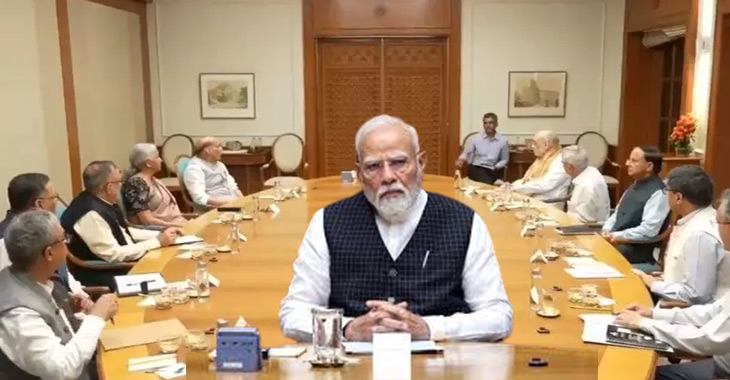

The February 28 airstrikes in Iran, the ensuing Middle East escalation, and the safety of Indian nationals in the area were all discussed with the Cabinet Committee on Security (CCS).
The CCS, which was led by Prime Minister Narendra Modi, examined the changing circumstances in West Asia on Sunday.
The meeting of the Cabinet committee, India’s highest decision-making body on security and strategic issues, took place in the midst of a rapidly worsening geopolitical situation in the Middle East as a result of coordinated US-Israeli airstrikes on Iran, which have escalated regional conflict and raised concerns about international security.
The meeting was attended by Foreign Secretary Vikram Misri, NSA Ajit Doval, External Affairs Minister S. Jaishankar, Finance Minister Nirmala Sitharaman, Home Minister Amit Shah, and Defense Minister Rajnath Singh.
The Committee was informed of the airstrikes in Iran on February 28 and the ensuing escalation, which included attacks in numerous Gulf nations, according to the official statement.The statement went on to say, “It voiced severe worry over the safety and security of the huge Indian expatriate community in the region.”
Along with the wider ramifications for regional security, economic, and commercial activity, the CCS also evaluated the difficulties encountered by Indian tourists passing through the area and students sitting scheduled exams.
“To help Indian nationals impacted by the developments, the CCS instructed the relevant ministries to take the required and practical actions. It emphasized how crucial it is that hostilities end quickly and that communication and diplomacy resume,” the official statement continued.
India has defended its residents and economic connections while promoting de-escalation in the Middle East conflict, maintaining a balanced position.
As tensions rise around the world, this is the most recent in a string of critical security reviews.
“India’s stance on the numerous current conflicts across the world is firm,” Prime Minister Modi stated during a joint press conference with Canadian Prime Minister Mark Carney. We have always advocated for stability and peace, and the voice for peace is amplified when two democracies unite.”
“The current situation in West Asia is a topic of grave concern for us,” he said, addressing the security worries in the Gulf countries. India is in favor of using diplomacy and communication to settle all conflicts. We shall keep collaborating closely with every nation in the area to guarantee the security of all Indian nations.”
These comments coincide with a growing Middle East crisis that erupted when the United States and Israel launched coordinated strikes on Iran with the goal of weakening Tehran’s missile capability and other military installations.
Tehran launched a massive counterattack in the form of drone and missile attacks against US assets, regional cities, and coalition forces around the Gulf after the operation’s initial wave purportedly killed top Iranian officials, including Supreme Leader Ayatollah Ali Khamenei.
Iran’s counterattacks have affected a number of nations, including Kuwait, Bahrain, and the United Arab Emirates, where missiles and drones were intercepted. This led to the temporary closure of airspace and the deaths of both military personnel and civilians.
US forces have launched counterattacks, including naval operations, in response to the escalating conflict, which has become one of the most intense and protracted standoffs between Washington and Tehran in decades.