

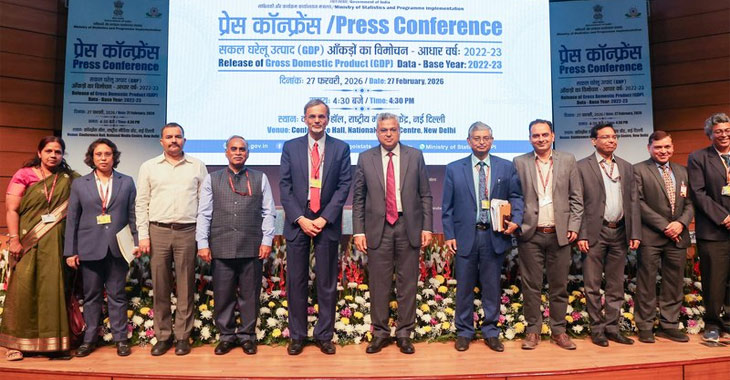

According to an official release, the Indian economy is expected to experience robust and long-term growth, with real GDP growth of 7.6% predicted for FY 2025–2026.
This strong performance supports India’s growth momentum and advances the country’s goal of realizing the “Viksit Bharat” vision, which is characterized by increased productivity, resilience, and inclusive development.
In light of this, moving the GDP base year to 2022–2023 is a big step toward bringing India’s national accounts into line with the realities of a constantly changing economy.
“The new series provides a more accurate, consistent, and comprehensive measure of economic activity by integrating improved data sources, strengthening methodological frameworks, expanding coverage of emerging sectors, and enhancing transparency through the SUT framework,” the statement reads.
The Indian statistics system is striving for more worldwide coherence, comparability, and precision. When taken as a whole, these initiatives bolster official statistics’ legitimacy and support their function as a solid basis for well-informed policymaking and sustainable economic planning.
The statement went on to say that India bases its GDP estimates on the internationally recognized statistical framework known as the 2008 System of National Accounts (SNA 2008).
India plans to conform to the upgraded standard in its upcoming base year revision as the UN Statistical Division moves to SNA 2025, which is anticipated to be adopted internationally around 2029–2030.
Furthermore, India complies with internationally accepted standards for statistical quality and transparency as a signatory to the IMF’s Special Data Dissemination Standard (SDDS). The updated GDP series is still completely compliant with global statistical norms.
India’s statistical system is undergoing a thorough modernization, with the base year for GDP estimates being changed to 2022–2023; the base year for the CPI being changed to 2024; and the IIP being changed to 2022–2023.
The base year modification of WPI is also underway, continuing this momentum. The current WPI will remain in use as a deflator until the revised WPI is made accessible.
In the near future, the MoSPI also intends to include the Producer Price Index (PPI). According to the statement, PPI calculates the rate at which the prices of goods and services that manufacturers purchase and sell fluctuate.