

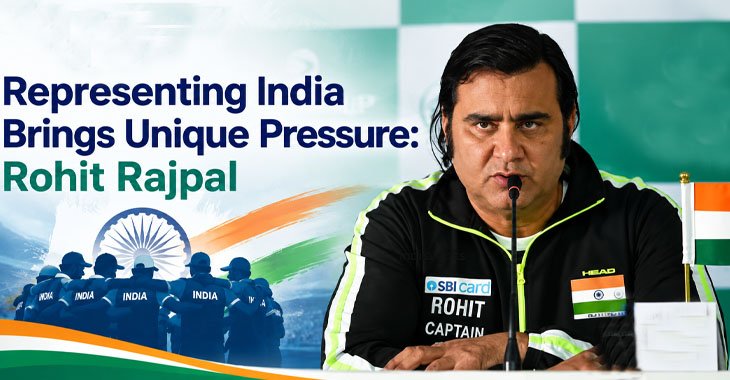

Playing for the country in marquee events such as the Asian Games and Davis Cup brings a distinct level of responsibility compared with competing in individual events throughout the year, said Rohit Rajpal, India’s non-playing Davis Cup captain.
Rajpal, who won a bronze medal in tennis at the 1990 Asian Games in Beijing, also expressed confidence that Indian tennis will continue its strong medal-winning tradition at the upcoming multi-sport event in Aichi-Nagoya, Japan, from September 19 to October 4.
The Asian Games will follow India’s Davis Cup World Group Qualifiers Round 2 tie against hosts South Korea in Seoul on September 18 and 19.
“No, it’s just completely different. I mean, there, you’re playing for yourself and your career. You do what you want. Here, you do have a responsibility because you’re playing for your country. So, it’s a different kind of pressure that playing for your country and your flag brings to you when in Davis Cup or playing in Asian Games,” Rajpal told VETO in an exclusive conversation facilitated by the subscription-free OTT platform.
Although India’s tennis contingent has been reduced from 12 to seven, leaving the country without representation in women’s singles, Rajpal remains optimistic about the team’s prospects in Japan.
“But from my times, I was saying earlier as well, I’m an Asian Games medallist. So, even before me, we have always contributed to the medals tally. Tennis has always contributed and we’ve done well for India.
“Even in the last Asian Games, we had three or four medals (one silver and one bronze in mixed doubles and men’s doubles in Hangzhou), if I can recollect. So, we will definitely be contributing this time too.”
Rajpal also discussed the long-standing challenge Indian players face when they transition from successful junior careers on the ITF circuit to professional tennis on the ATP Tour. He attributed part of the difficulty to cultural and developmental factors but noted that modern training methods and stronger support systems are helping Indian players close the physical gap.
“So, the transition traditionally has been a very difficult task because genetically, Indians mature later than, for example, Europeans or Americans. We’ve seen that they mature later – their bodies and mind matures later. That is because of how we are brought up – our family values, etc. We still treat them as children when they are 17 and 18.
“Over there, you need to leave your home and start working and fending for yourself at that age. Once you’re done and you’re expected to build your own life from there. So, all those things really come into play as your personality development, etc and that kind of reflects on the court as well or in sport, any sport that you play. But that is changing as we go along because the game has gotten much more physical.”
Rajpal said Indian players also need structured support to bridge the physical and mental gap as they begin competing against more experienced professionals who are often several years older.
“Then we have good physios and the boys are really, really focused on bridging that gap.
“Also, what happens is that when you’re suddenly playing juniors and you cross that 18 mark and you start playing or even earlier, feature in the men’s game, you’re suddenly playing against players who are 10 years older to you – stronger and more mature.
“So, you need to match up to them and that’s where the problems start coming – that if you’re not physically or mentally not strong enough to match them. So, these are transitional issues that every player faces.
“But we are getting better and better at that now. I think more and more effort will be needed so that the transition period you spend in the same ecosystem where everybody else is transitioning – that it’s a level playing field for everybody,” he concluded.