

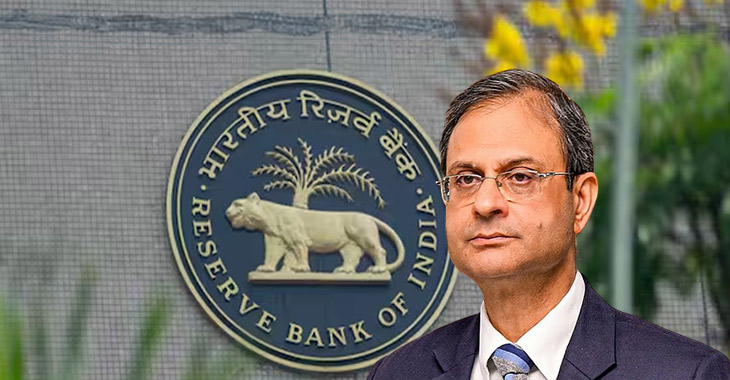

The central bank will maintain the current interest rate policy in the face of erratic worldwide circumstances brought on by the escalating tensions in West Asia.
The Monetary Policy Committee (MPC) of the Reserve Bank of India (RBI) commenced its three-day policy meeting on Wednesday. Sanjay Malhotra, the governor, will make public the policy choice on Friday.
The June assessment is taking place against a backdrop of volatile global oil and gas prices and ongoing geopolitical tensions, which have made the prognosis more difficult.
However, while the majority of economists expect the RBI to maintain rates in the next policy result, they also anticipate a more cautious or hawkish communication due to continuing external obstacles.
According to Pranjul Bhandari, HSBC’s chief India economist, the central bank is expected to remain in a holding pattern in the near term but with a gradual tightening bias emerging over time, with markets pricing in approximately two rate cuts starting in the fourth quarter of 2026 instead of an aggressive tightening cycle.
According to her, the RBI’s updated projections will be closely watched for its evaluation of the continuing energy shock and whether it raises its crude oil assumption over earlier levels of roughly $85 per barrel.
Bhandari further said that a higher baseline scenario might raise inflation predictions closer to 5% rather than the previous estimate of 4. 6%.
According to a CareEdge Ratings analysis, inflationary pressures have increased as a result of recent retail fuel price rises and below-normal monsoon expectations, as well as the risk of quicker second-round pass-through from high wholesale price inflation to retail inflation.
The study stated that the current rise in inflation is primarily caused by supply rather than demand. It forecast 6. 7 percent GDP growth for FY27, assuming an average crude price of around $90 per barrel. However, it cautioned that prolonged conflict and oil prices close to $110 per barrel might push growth closer to 6 percent.
Furthermore, SBI Research projected that the RBI would maintain the repo rate unchanged, citing a data-dependent strategy in the face of ongoing inflation threats and external instability.
It projected that CPI inflation would stay above 5% for multiple quarters due to global shocks and fuel price pressures, while GDP growth would be around 7. 5% in FY26 and 6. 6% in FY27.
Emkay Global Financial Services also projected a unchanged rate, citing falling crude prices and an improved external account outlook following a recent correction in Brent oil.
According to the brokerage, a protracted pause in policy rates and assistance for the rupee may be achieved by lower oil prices and any easing of geopolitical tensions.