

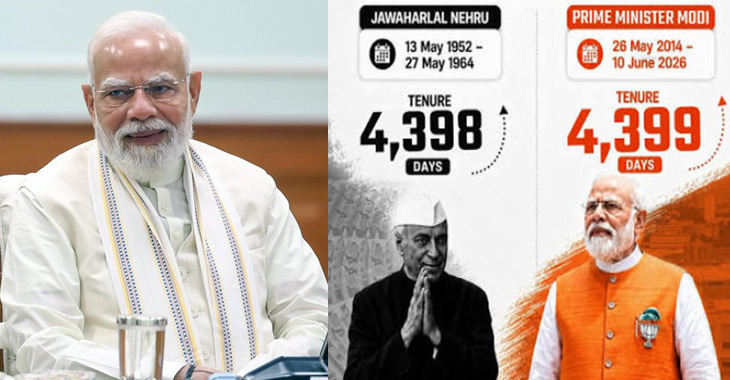

Prime Minister Narendra Modi reached 4,399 days in office on Wednessday, becoming India’s longest-serving elected leader.
The milestone was praised by the PM and Union ministers as evidence of the public’s confidence in him emphasizing the government’s development, welfare, and reform initiatives throughout the previous 12 years and demonstrating leadership.
What started in 2014 as a country struggling under the label of the Fragile Five? Now, economies have established themselves as the world’s most rapidly expanding large economy, fearlessly making headway toward the ambitious aim of becoming a $5 trillion economy.
This comprehensive plan details the last twelve years of the Union administration under Prime Minister Narendra Modi. not only about statistics, but it also reflects a shared aim where every citizen is viewed as a nation builder who supports a bigger ideal of autonomy and affluence.
The study, titled Rashtra Nirman (Nation Building), illustrates how India has changed from being one of the fragile five economies in 2013 to being the world’s fastest-growing big economy.
Current prices in the fiscal year (FY) 2025-26 show that India’s GDP has reached 345 lakh crore rupees. According to the report, the nation is quickly advancing toward a five-trillion-dollar economy.
The GDP of India has increased quickly after reaching $1 trillion after six decades following independence.
Rashtra Nirman said in a statement that by 2014, the economy had reached $2 trillion, and within a decade it had surpassed $4 trillion, and is now ready to reach $5 trillion in the following two years.
India, according to the World Bank, has emerged as the second-largest driver of global GDP growth, which is evidence of strong changes, digital transformation, and all-inclusive policies.
Inflation, formerly a continuous problem, has been brought under control, dropping from almost 10 per cent at the beginning of last year to a level that is manageable. from almost eight per cent in the early 2010s to less than five per cent in recent years, alleviating family pressure. budgets while sustaining development momentum.
This change is best illustrated by the electronics industry. Exports surged by 800% over the previous year. 38 million crore to 3. Production increased sixfold to Rs 11 lakh crore, while expenditure grew by three. Three lakh crores. Exports of mobile phones alone increased by 163 times, from a small Rs 0. from Rs 1. 016 lakh crore in 2014 to Rs 2. 2026 will see a 6 lakh crore increase.
The Production Linked Incentive program and semiconductor investments totaling 1. 83 trillion rupees are fueling this boom. India has established itself as a global center for production and created over 2. 5 million jobs thanks to investments of over 64 lakh crore.
The India Semiconductor Mission 2. 0. With 12 approved projects spread over six states, the government is establishing the groundwork for technological self-sufficiency, ensuring strong supply chains and reasonably priced electronics.
In 2025–2026, public sector banks, which had previously been burdened with non-performing assets, made a record profit of over Rs 2 lakh crore, marking a remarkable comeback.
The gross NPAs decreased from 4. from 4 percent in 2014 to barely 1. 93 percent by 2026, boosting credit accessibility and lowering financial strain.
In a similar vein, Rs 51 lakh crore in direct benefit transfers have been sent to citizens, removing leakages and guaranteeing that welfare programs reach the populace at the grassroots level.
India’s entrance into green aviation was heralded by sustainable aviation fuel projects and the rapid expansion of the aviation industry, which saw airports grow from 74 in 2014 to 164 in 2026.
The great equalizer has emerged in the form of technology. UPI has transformed transactions, with over 2,300 crore transactions totaling Rs 30 lakh crore occurring in March 2026.
Real-time payments in India currently make up 49% of all real-time payments made worldwide.
The number of Internet connections increased fourfold to 103 crore, with 5G services now available to 99 percent of the population. 9% of the districts.
Citizens’ participation has increased thanks to digital platforms such as DigiLocker, which has released 950 crore papers, and MyGov, which has six crore members.
The JAM trinity (Jan Dhan-Aadhaar-Mobile) allowed for seamless welfare delivery to over 58 crore beneficiaries as Aadhaar coverage increased to 144 crore.
Along with domestic advancement, India’s international standing has increased.
Nine significant free trade agreements, covering 38 countries, have been finalized, with six of them scheduled between 2024 and 2026, leading to a record-high export figure of Rs 79 lakh crore.
Underlining resilience against global shocks, foreign exchange reserves now cover 94% of external debt and eleven months of imports.
Rural incomes and the economies of small towns were bolstered even more by remittances totaling Rs 13 lakh crore in FY25–26.
The formerly marginalized Northeast has been integrated into the mainstream. The area is now considered to be a doorway to India’s prosperity and security, thanks to Prime Minister Modi’s over 83 visits in twelve years.
The landscape has been changed by road, bridge, and connectivity projects, bringing it more in line with the nation’s expansion narrative. This twelve-year road is about trust as much as statistics.
Reforms to taxation, including the new regime that excludes incomes up to Rs 12. While faceless tax systems boosted transparency, 75 lakh alleviated the burden on the middle class.
Strengthening trust in governance, citizens now see their money represented in roads, hospitals, and schools.
The rise of India from the Fragile Five to a confident, rapidly expanding economy is a narrative of tenacity, change, and unwavering desire. It is a story of technology enabling the poorest, infrastructure meeting innovation, and every citizen contributing to the development of the country.
As India approaches its one hundredth anniversary of independence, the dream of a developed, self-sufficient country is no longer a distant possibility, but rather a reality that is becoming apparent to the globe.
Piyush Goyal, the Union Minister for Commerce and Industry, called the event a historic day and stated that PM Modi’s leadership over the previous twelve years had brought about transformative changes that had altered India’s growth path.
Goyal wrote on X that the benefits of every significant programme started by the PM Modi administration have reached the grassroots level, empowering millions nationwide, from farmers to entrepreneurs, women to MSMEs, and youth to the middle class.
Nirmala Sitharaman, the Union Minister for Finance and Corporate Affairs, stated that Prime Minister Modi’s administration was characterized by resolute leadership during difficult times and was founded on the idea of Antyodaya.
The government’s guiding philosophy of Sabka Saath, Sabka Vikas, Sabka Vishwas, and Sabka Prayas, she added, made sure that every citizen received the benefits of development while acknowledging each person’s role in building the country.
Sitharaman said that the Modi-led NDA administration has taken historic steps and implemented a number of programs with unparalleled speed and size.
Jyotiraditya M. Scindia, the Union Minister for the Development of the North Eastern Region (MDoNER), hailed the achievement as evidence of PM Modi’s dedication to a Nation First strategy and the confidence of 140 million Indians.
Bharat has undergone a significant shift in the previous 12 years. Citing welfare initiatives, women’s empowerment, youth development, support for farmers, and India’s increasing global stature, he stated that what was formerly aspiration has progressively turned into accomplishment.
According to Union Minister for Petroleum and Natural Gas Hardeep Singh, after serving 12 years as Prime Minister and becoming India’s longest-serving elected PM, PM Modi had attained a historic milestone.
Throughout the time, Puri emphasized accomplishments in social empowerment, infrastructure expansion, digital transformation, economic growth, and India’s stronger worldwide presence.
He stated that the government’s emphasis on inclusive development and citizen welfare was shown by initiatives including the Swachh Bharat Mission, Smart Cities Mission, PM SVANidhi, metro rail expansion, the UDAN scheme, and the Ujjwala Yojana, which he referred to as flagship programs.
He further stated that the goal of a Viksit Bharat was to give dignity, opportunity, and optimism to every citizen, not simply to become a developed nation by 2047.
Furthermore, the ministers emphasized that India’s journey toward becoming a developed country by 2047 would continue to be shaped by PM Modi’s vision, which has been supported by a series of electoral mandates.