

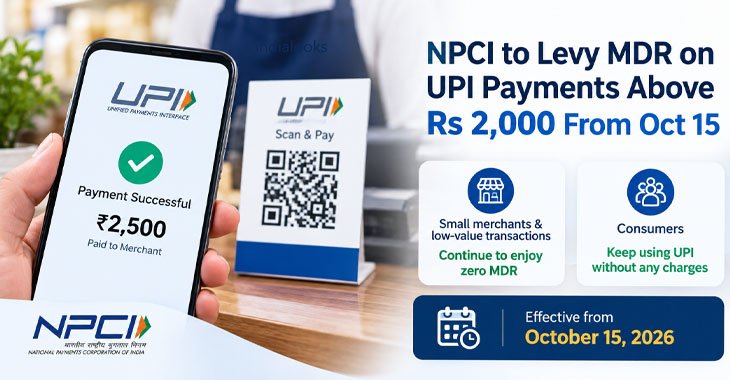

The National Payments Corporation of India (NPCI) on Tuesday announced a revised Merchant Discount Rate (MDR) framework for select UPI transactions. The framework will introduce charges for certain merchant payments above Rs 2,000, while small merchants and low-value transactions will continue to enjoy zero MDR.
The revised framework will take effect from October 15, 2026. Consumers will continue to use UPI without paying transaction charges. More than 95 per cent of low-value UPI Person-to-Merchant (P2M) transactions involving payments of up to Rs 2,000 will remain outside the MDR framework.
Under the new framework, merchants will pay an MDR of 0.4 per cent on specified P2M UPI transactions above Rs 2,000. NPCI will cap the MDR at Rs 300 per transaction. Selected merchant categories, including railways, telecom services, insurance and fuel, will pay a flat MDR of Rs 5 per transaction for UPI payments above Rs 2,000.
Person-to-Person (P2P) transactions will continue to carry no charges, while P2M transactions of up to Rs 2,000 will also remain outside the MDR framework. Consumers will therefore continue to use UPI without paying transaction charges.
Small merchants operating under the Person-to-Person Merchant (P2PM) framework will continue to enjoy zero MDR. The category covers small vendors who receive up to Rs 1 lakh per month through UPI QR payments directly into their bank accounts. The framework supports wider digital payment acceptance across the unorganised retail sector.
The revised framework also proposes a dedicated fund to expand UPI acceptance among small merchants, particularly across existing merchant networks and Tier-3 and smaller markets. The initiative aims to strengthen digital payment infrastructure and encourage more small businesses to adopt UPI.
The Finance Ministry on Wednesday rejected claims that foreign influence prompted the MDR change in the UPI ecosystem. The ministry stressed that India makes its digital payments decisions independently.
Since its launch in 2016, UPI has grown into the world’s largest real-time interoperable payment system, entirely on India’s own terms, the ministry said in a post on X.
The ministry called such claims “false” and said India makes UPI policy decisions independently with the goal of building a self-sustaining, inclusive and affordable digital payments ecosystem.
UPI processed 24.5 billion transactions in August 2026 alone. The government said a small fee on high-value merchant transactions will help keep the system self-sustainable, secure and innovative. The fee will support better infrastructure and cybersecurity, small merchants in Tier III–VI towns and rural areas, and awareness campaigns and incentives that encourage wider UPI adoption.
“The new framework ensures resources from higher-value merchant transactions are reinvested to support small businesses and strengthen digital payments across the country,” the Finance Ministry said.
UPI will continue to remain free for customers. Consumers can send money to friends, pay at shops and scan QR codes without paying transaction charges.
“Person-to-Person transfers are always free, regardless of amount. Vendors earning up to Rs 1 lakh per month via UPI QR codes continue to enjoy zero charges. Over 95 per cent of merchant payments are below Rs 2,000 — these remain free,” the ministry said.
Only larger merchant transactions above Rs 2,000 will attract the 0.4 per cent MDR, which merchants will pay. The rate remains lower than charges associated with credit cards and other payment networks, according to the government.
Railways, fuel, telecom, bill payments and insurance will attract a flat fee of Rs 5 per transaction above Rs 2,000. Mutual fund and securities payments will attract an MDR of 0.02 per cent, capped at Rs 300.
“Merchants cannot pass MDR costs to customers. UPI apps cannot levy platform charges,” the ministry said.
“No, there are no fees for customers on UPI at all. Customers have never been charged for using UPI, nor will they be charged in the future,” PhonePe CEO, Sameer Nigam said.
“UPI has already transformed the Indian economy, but the ecosystem also needs a sustainable economic model to support its next phase of growth,” MobiKwik Co-founder, Executive Director and CFO, Upasana Taku said.