

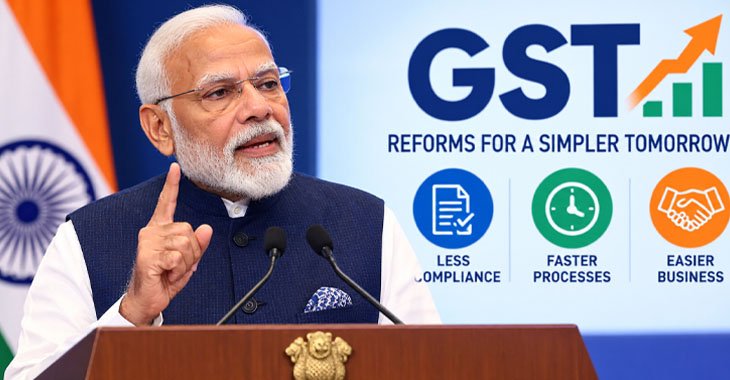

Prime Minister Narendra Modi on Monday said the next phase of GST reforms will simplify compliance and improve the refund process, giving businesses greater confidence to invest and expand.
“These reforms will strengthen the foundation for a Viksit Bharat,” the Prime Minister said.
Modi was referring to Finance Minister Nirmala Sitharaman’s article, in which she said the next-gen GST regime is making taxation simpler and more predictable while supporting businesses and households. The reforms aim to expand economic activity, strengthen revenues and create more opportunities for enterprises across India.
Sitharaman said in a post on X that next-gen GST is pursuing two objectives: providing relief to taxpayers and giving greater momentum to the economy. She said the next phase will simplify compliance across registration, returns, refunds, disputes and input tax credit.
The Finance Minister outlined the government’s case for the next phase of Goods and Services Tax reforms ahead of the GST Council meeting on October 7.
In her article, Sitharaman said the proposed process reforms will focus on registration, returns, refunds, dispute resolution and the flow of input tax credit. The measures aim to reduce the time and cost businesses spend on compliance.
She also highlighted GST collection trends and taxable supplies following the rate rationalisation that took effect on September 22, 2025.
The GST Council may also consider removing the standalone provision that allows tax officials to arrest taxpayers during GST investigations, a senior official said. The government is considering the move after instances of alleged misuse came to light.
The proposal forms part of broader recommendations from the GST Council’s Law Committee on decriminalising GST offences. The committee has noted that taxpayers may sometimes fail to pay tax without deliberately intending to evade it.
If the Council approves the proposal, tax officials would no longer have the power under Section 69 of the CGST Act to arrest taxpayers during GST investigations.
Under the current framework, Section 69 allows the Commissioner to authorise an arrest when there are reasons to believe that a person has committed specified serious offences under Section 132.
Under the proposed approach, authorities could pursue serious cases involving fake invoicing, fraudulent input tax credit and fake refund claims under the general criminal law provisions of the Bharatiya Nyaya Sanhita (BNS).
The GST Council’s Law Committee comprises officials from the Centre and state governments. It examines legal provisions under GST laws and recommends statutory amendments and clarifications to the GST Council.