

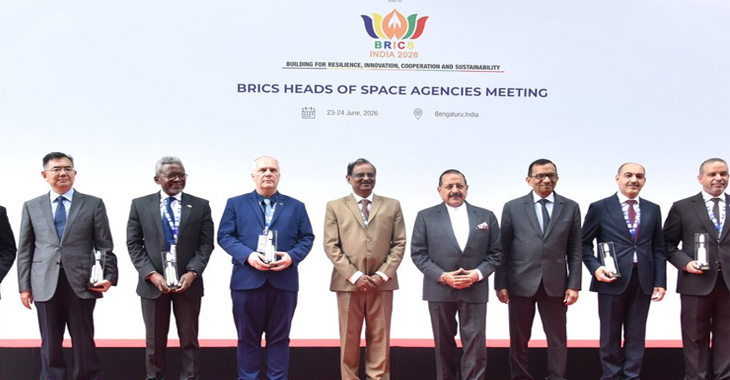

Union Minister Dr. Jitendra Singh proposed “BRICS Space Economy” as the next frontier of global expansion on Wednesday and urged member states to work together to create new possibilities in innovation, investment, entrepreneurship, and sustainable development.
Dr Singh said BRICS nations have the scale, scientific skills, technical strengths, and industrial capacity needed to become a significant force in the rapidly expanding global space economy while speaking at the BRICS Heads of Space Agencies (HOSA) meeting in Bengaluru.
“Nations working alone will not determine the course of the space economy. ” Collective ambition, shared innovation, and partnerships will shape it. He told the gathering that “BRICS countries have the potential to become one of the most powerful foundations of this growing global space ecosystem. ”
The minister reaffirmed India’s commitment to collaborating closely with all BRICS partners in order to convert shared goals into tangible outcomes and guarantee that space continues to be a driving force behind growth, fortitude, creativity, sustainability, and global cooperation.
The two-day conference, which was held by the Indian Space Research Organisation (ISRO) in conjunction with India’s BRICS Chairship 2026, gathered Heads of Space Agencies and senior officials from Brazil, China, Egypt, Ethiopia, Indonesia, Iran, Russia, South Africa, and the United Arab Emirates.
It examined the BRICS’ space cooperation’s progress and discussed vital topics such as space sustainability, debris-free missions, fortifying the BRICS Remote Sensing Satellite Constellation (RSSC), bringing more new BRICS members into current cooperation frameworks, and furthering talks on the proposed BRICS Space Council.
Dr. Singh stated that space technology has emerged as one of the most potent drivers of economic transformation and societal advancement, allowing countries to improve communication networks, navigation systems, disaster preparedness, agriculture, healthcare, education, and environmental monitoring.
Speaking on the rising prominence of BRICS in the global space landscape, the minister stated that the group accounts for a sizable portion of the world’s population, economic output, scientific knowledge, and technical capabilities.
He claimed that greater collaboration between BRICS nations may open up new possibilities for innovation, industrial alliances, technology transfer, investment, and economic development while tackling shared development objectives.