

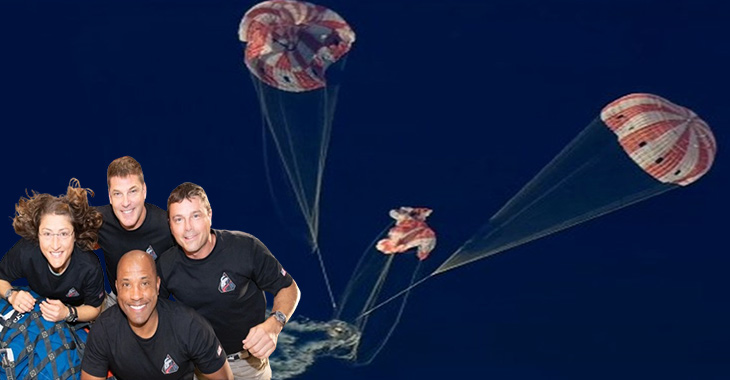

With the four-person crew of Reid Wiseman, Victor Glover, Christina Koch, and Jeremy Hansen safely splashing down after a historic ten-day trip around the Moon on the Orion spacecraft, NASA’s Artemis II mission has come to a successful conclusion, marking a significant step toward humanity’s return to deep space exploration.
“Welcome home Reid, Victor, Christina, and Jeremy! ” NASA tweeted on X. At 8:07 p. m. ET (0007 UTC April 11), the Artemis II astronauts landed, completing their groundbreaking 10-day journey around the Moon.
In an earlier piece, the agency emphasized the spacecraft’s descent, saying, “Orion’s main parachute has deployed. ” The spacecraft will slow down from roughly 300 mph to 20 mph in preparation for splashdown, thanks to a mechanism of 11 chutes.
The crew was getting closer to Earth after a trip of over 690,000 miles, according to NASA, before they arrived.
The mission has gained worldwide recognition because it is the first time in more than 50 years that mankind has resumed deep space exploration beyond low Earth orbit. Highlighting its importance in paving the way for future lunar missions, NASA characterized the trip as one that transported astronauts farther than anyone had ever traveled before.
The crew covered 248,655 miles from Earth during the voyage, establishing a new distance record, and ultimately arrived to around 252,756 miles at the furthest point.
With this, a new standard for human space travel is established, exceeding the prior record established during the Apollo 13 mission.
The purpose of the expedition, according to officials, was to thoroughly evaluate the Orion spacecraft and the Space Launch System rocket in a deep-space setting with astronauts on board. A crucial phase in the process of confirming the systems that will enable future operations targeted at bringing people back to the Moon was the lunar flyby.
According to Dr. Lori Glaze, acting associate administrator of NASA’s Exploration Systems Development Mission Directorate, the accomplishment demonstrates the agency’s dedication to breaking barriers. Hansen stated from orbit that this historic moment marks the legacy of earlier space explorers and the beginning of a new age of discovery.
Many consider Artemis II to be a significant advancement in NASA’s long-term aim of creating a continuous human presence on the Moon, paving the way for future, more ambitious missions.