

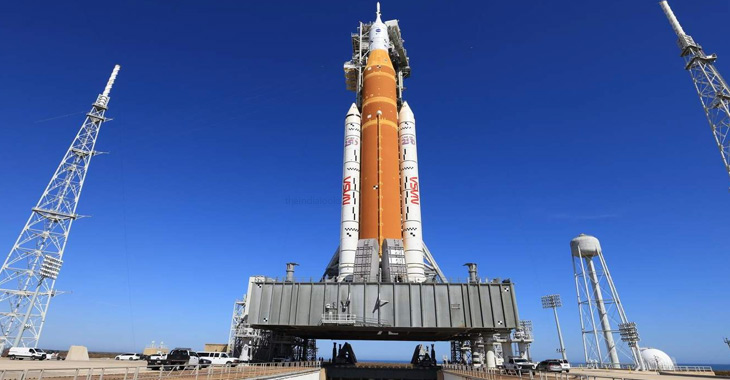

The ‘Artemis II’ mission, which is slated to launch from Kennedy Space Center as early as April 1, has had its final preparations finished by the US National Aeronautics and Space Administration (NASA).
The mission, which will send four astronauts on a roughly 10-day trip around the Moon, will be the first crewed flight under NASA’s Artemis program, according to the agency.
Additionally, since the Apollo era, Artemis II will be the first time humans have ventured outside of low-Earth orbit.
The crew consists of Canadian Space Agency astronaut Jeremy Hansen as well as NASA astronauts Christina Koch, Victor Glover, and Reid Wiseman.
The Orion spacecraft’s life-support systems will be tested with humans onboard for the first time during the mission, which will be launched from NASA’s Space Launch System rocket.
Despite the possibility of cloud cover and strong winds, NASA stated that the weather prediction for launch day is still good, with an 80% chance of favorable conditions.
After launching, the spacecraft will go to high Earth orbit before following a ‘free-return trajectory’ toward the Moon, which will bring it around the far side of the Moon and back to Earth without the need for propulsion for the return trip.
The crew is also anticipated to break the record for the farthest distance humans have traveled from Earth, which was established during the Apollo 13 mission.
The mission will evaluate vital systems, such as emergency protocols, radiation shielding, and cutting-edge communication technologies like laser-based data transmission.
Artemis II, according to NASA, is a crucial advancement in the direction of future deep-space exploration, such as crewed missions to the Moon and eventually Mars.
Through its official channels, such as live streams and frequent status updates, the space agency will offer ongoing coverage of the launch and expedition.
As part of its larger initiative to establish a long-term human presence on the Moon and develop skills for potential missions to Mars in the future, NASA’s Artemis program is included.