

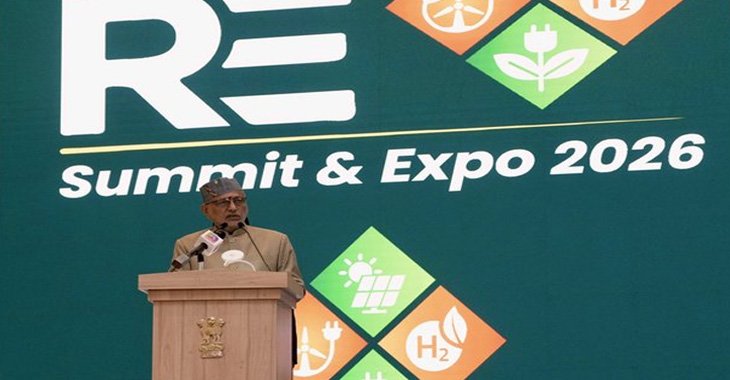

Vice-President C.P. Radhakrishnan said on Thursday that India’s remarkable progress in renewable energy serves not only as an exemplary achievement for the country but also as a model for the Global South.
Addressing the valedictory session of the Bharat Renewable Energy Summit and Expo 2026, the Vice-President highlighted India’s achievement of crossing 300 gigawatts (GW) in non-fossil fuel-based installed capacity. He noted that the country reached 50 per cent of its total installed electricity capacity from non-fossil fuel sources in 2025, five years ahead of its target.
India’s solar power capacity has also surged from less than 3 GW to more than 170 GW over the past decade, he said.
The Vice-President pointed out that solar power, which once cost several times more than coal-based electricity, now ranks among India’s cheapest sources of electricity. He attributed this transformation to sound government policies, private enterprise and the collective efforts of states and citizens.
He said more than 65 lakh households have joined the solar movement through the PM Surya Ghar Muft Bijli Yojana, gaining access to affordable clean energy.
He also highlighted the benefits of the Pradhan Mantri Kisan Urja Suraksha evam Utthan Mahabhiyan (PM-KUSUM) scheme, which has helped nearly 30 lakh farmers. Solar pumps help farmers reduce diesel expenses, earn additional income and become Urjadatas, contributing both energy and food, he said.
The Vice-President noted that initiatives such as the Pradhan Mantri Janjati Adivasi Nyaya Maha Abhiyan (PM-JANMAN) and the Dharti Aaba Janjatiya Gram Utkarsh Abhiyan are expanding electricity access in remote tribal areas where conventional grid connectivity may not prove feasible.
He emphasised that electricity access transforms lives by creating opportunities in education, healthcare, communication and livelihoods. He added that India must develop energy solutions that address the distinct requirements of cities, villages and remote habitations.
Radhakrishnan also highlighted the encouraging progress of hydrogen energy in India. He expressed confidence that advances in science and technology would make hydrogen energy increasingly affordable in the coming years.
Recalling earlier doubts about whether a developing country as large as India could sustain rapid economic growth while reducing its dependence on fossil fuels, the Vice-President said India’s achievements had answered those concerns.
He said the country’s progress over the past decade had vindicated Prime Minister Narendra Modi’s vision that environmental commitments can drive economic growth. These efforts have expanded energy access, reduced industrial costs and import dependence, and created employment opportunities, he said. He also called for stronger collaboration between industry and academia.
“The technologies of 2040 will come from the laboratories and start-ups of today,” the Vice-President said, underlining the importance of research, innovation and entrepreneurship.
Describing the renewable energy transition as a Jan Andolan, or people’s movement, envisioned by the Prime Minister, Radhakrishnan said the government alone could not drive the transformation.
He called on teachers, students, entrepreneurs and citizens to participate actively in the movement.
He added that greater public participation would accelerate renewable energy adoption, create new economic opportunities, generate livelihoods and improve household prosperity.