

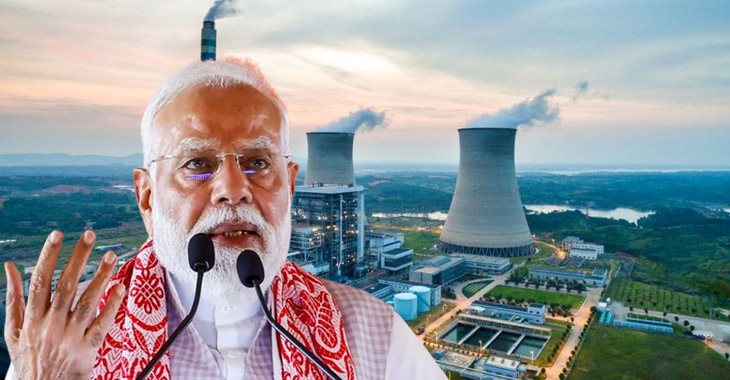

Prime Minister Narendra Modi commended the country’s experts on Monday for designing and building the Prototype Fast Breeder Reactor in Kalpakkam, Tamil Nadu.
India has made a significant move in its civil nuclear path by moving forward with the second phase of its nuclear program, according to the Prime Minister. “The Prototype Fast Breeder Reactor at Kalpakkam, which was built and designed indigenously, has achieved criticality,” he stated.
The Prime Minister continued by saying that this cutting-edge reactor, which can generate more fuel than it uses, demonstrates the sophistication of the nation’s scientific capacity and the robustness of our engineering business. In the program’s third stage, according to Prime Minister Modi, it is a decisive move toward utilizing our extensive thorium resources.
PM Modi said that it is a decisive step towards harnessing our vast thorium reserves in the third stage of the programme.
“A proud moment for India.The Prime Minister expressed his gratitude, saying, “Congratulations to our scientists and engineers. ” The start of “core loading” at the 500 MWe PFBR plant in Kalpakkam, Tamil Nadu, was observed by Prime Minister Modi in 2024.
He was given a tour of the reactor vault and control room during the visit, as well as an overview of the facility’s main components.
India will be the second nation, after Russia, to run a commercial Fast Breeder Reactor once it is operational. As a demonstration of the Aatmanirbhar Bharat campaign, BHAVINI created and built the PFBR entirely locally, with substantial support from more than 200 Indian industries, including micro, small, and medium businesses (MSMEs).
At first, the reactor will run on a mixed oxide (MOX) fuel made of uranium and plutonium.
Reflecting the Aatmanirbhar Bharat initiative, the PFBR was fully designed and constructed indigenously by BHAVINI, with significant contributions from over 200 Indian industries, including micro, small, and medium enterprises (MSMEs).
The reactor will initially use Uranium-Plutonium mixed oxide (MOX) fuel. The term “breeder” refers to the Uranium-238 “blanket” surrounding the fuel core, which undergoes nuclear transmutation to generate more fuel. At this point, Thorium-232 will also be used as a blanket.
“Through transmutation, thorium will produce fissile Uranium-233, which will be utilized as fuel in the third stage,” the Prime Minister had said. In this way, the FBR acts as a bridge to the third phase of India’s nuclear program, enabling the complete use of the nation’s vast thorium resources.
The nuclear fuel may also be extracted from India using thorium cycle-based methods.
The FBR thus functions as a stepping stone for the third stage of India’s nuclear programme, facilitating the full utilisation of the country’s abundant thorium reserves.
India can also use thorium cycle-based processes to extract nuclear fuel.
This is particularly relevant to India’s nuclear energy production plan since India possesses one of the world’s biggest thorium deposits, which may be utilized to generate electricity for up to 60,000 years.