

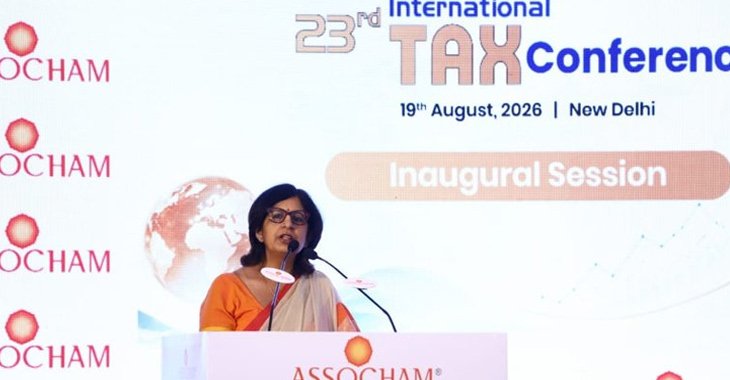

India’s international tax framework stands at a critical juncture, and the country needs to balance tax-base protection with policy stability, predictability and certainty for global investors, Monica Bhatia, Principal Chief Commissioner of Income Tax (International Tax), said on Wednesday.
Addressing the 23rd International Tax Conference organised by ASSOCHAM, Bhatia said the Supreme Court’s Tiger Global judgment, the new Income-tax Act, evolving dispute-resolution mechanisms and rapid technological advances are reshaping India’s international tax landscape.
“Policy stability is foundational to investor confidence,” Bhatia said. She also highlighted government measures following the Tiger Global judgment that aim to provide greater certainty for bona fide legacy investments.
Bhatia also highlighted India’s progress in advance pricing agreements (APAs). She said the country has crossed the 1,000-agreement mark, including more than 220 bilateral agreements.
Looking ahead, the senior Income Tax official said artificial intelligence is changing business models as well as tax administration. This transformation raises new questions about permanent establishment, profit attribution and the location of value creation.
She stressed that international cooperation and consensus-based global rule-making will become increasingly important as technology advances faster than existing tax rules.
Rakesh Nangia, Chairman of ASSOCHAM’s Task Force on International Taxes, said international taxation has moved from rapid evolution to a period of fundamental transition. He identified the Tiger Global judgment, new tax legislation, global minimum tax developments and AI as key forces shaping the next phase.
Sandeep Chaufla, Chairman of ASSOCHAM’s National Council on Direct Taxes, said governments seek to protect their tax bases while taxpayers demand certainty and predictability.
“Balance in terms of legislation and its implementation is the need of the hour,” he said, while highlighting AI’s growing role in tax administration.
The event also examined the post-Tiger Global tax landscape, AI and international tax policy, BEPS 2.0, treaty evolution, the new Income-tax Act, APAs, safe harbours and cross-border dispute resolution.