

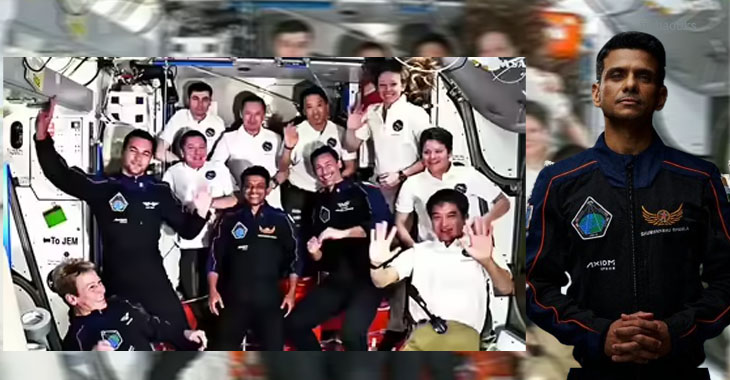

Indian astronaut Shubhanshu Shukla became the first Indian to reach the orbiting laboratory on Thursday when he successfully docked at the International Space Station (ISS) after a long and arduous 41-year wait.
After 41 years, India now has an astronaut in space. After Rakesh Sharma’s 1984 journey, Shukla, who was born in Lucknow, will also be the second Indian in space.
At 6:30 a.m. ET (4:00 p.m. IST), Shukla and three other passengers from the US, Poland, and Hungary have docked to the Harmony module’s space-facing port aboard Axiom Space’s mission -4.
Ax-4 Commander Peggy Whitson, Pilot Shubhanshu Shukla, and Mission Specialists Sławosz Uznański-Wiśniewski and Tibor Kapu are aboard the SpaceX Dragon spaceship “Grace.”
“Docking confirmed!” In a post on the social media site X, SpaceX stated.
The crew boarded a new SpaceX Dragon spacecraft on the company’s Falcon 9 rocket and took off for the ISS at 2:31 a.m. EDT (12 noon IST) from Launch Complex 39A at NASA’s Kennedy Space Center in Florida.
“Hello everyone, from space, Namaskar. Being here with my fellow astronauts makes me very happy. What a journey it was. “Let’s just go,” said Group Captain Shukla, “was all I could think of as I was sitting in the capsule on the launchpad.
“Something was pushing you back in the seat when the ride began. The ride was incredible. Then all of a sudden there was nothing. He said, “You are floating in a vacuum,” as he described his time in space.
“I am learning like a baby; how to walk and eat in space,” he stated.
The mission “is the journey of India’s human space flight,” he had previously stated.
To satisfy his appetites for home-cooked meals while in space, Shukla is also bringing carrot halwa, moong dal halwa, and mango nectar.
In addition to being a scientific achievement, the Axiom-4 Mission provides evidence of India’s growing influence as a major player in technology worldwide. It strengthens the country’s capacity to spearhead space innovation, advance sustainability, and make a significant contribution to international missions.
Shukla will carry out groundbreaking research on food and space nutrition once she is on board the ISS.
With assistance from NASA, ISRO and the Department of Biotechnology (DBT) collaborated to develop these tests, which are intended to advance knowledge of sustainable life-support systems, a critical component of long-duration space flight in the future.
Additionally, the study will examine how edible microalgae—a nutrient-rich, very promising food source for upcoming space missions—are affected by microgravity and space radiation.
In addition to analyzing transcriptome, proteomic, and metabolomic alterations in several algae species in space as opposed to their behavior on Earth, the experiment will assess important growth indices.