

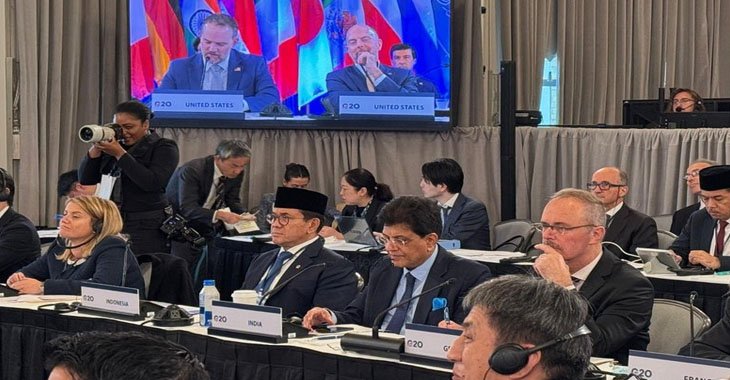

India has cautioned G20 members against labeling legitimate national measures to protect food security as the “weaponisation” of food, as trade ministers began discussions on coercive trade actions involving food and agricultural supplies.
Commerce and Industry Minister Piyush Goyal made the distinction during a G20 Trade Ministers’ Meeting session in Milwaukee focused on the “Weaponisation of Food through Coercive Trade Action”.
“Our shared objective must be to ensure that food remains a source of security, stability and cooperation,” Goyal said in a post on X after addressing the session.
Goyal also stressed the need to distinguish between coercive actions involving food supplies and government measures that address legitimate domestic requirements.
“We must clearly distinguish between the weaponisation of food supply chains and legitimate measures adopted by countries to pursue domestic policy objectives and address food-security needs,” Goyal said.
India raised the issue as the United States, host of the G20 Trade Ministerial, placed food weaponisation among four key issues for trade ministers to discuss during the two-day meeting.
US Trade Representative Jamieson Greer said coercive trade measures involving food could create consequences that extend beyond conventional trade disputes.
“Coercive trade actions involving food, agricultural products, and agricultural inputs pose serious consequences for economies and the people in them,” Greer said in his opening remarks.
The US G20 presidency has identified four key workstreams for the meeting. Along with food weaponisation, the agenda covers structural excess capacity and production, the Most-Favoured-Nation principle and forced labour in global supply chains.
Greer urged G20 members to address difficult questions affecting the international trading system directly rather than leave them solely to discussions at the World Trade Organization (WTO) in Geneva.
“Typically, and too often, when difficult questions and topics arise in the G20, many around the room suggest that such discussions belong elsewhere. That they should take place in Geneva at the WTO. But Geneva is just another city on a lake. And so is Milwaukee. So, let’s talk candidly and constructively here,” Greer said.
The US trade representative argued that years of discussions had failed to adequately address structural challenges facing global trade.
“For more than a decade, the global economy has been beset by macroeconomic imbalances, structural excess capacity and production, forced labour, and economic coercion. And yet, the response by the world’s economies has been mostly talk,” Greer said.
Greer said the United States wanted the Milwaukee meeting to create greater urgency among G20 economies and encourage concrete action.
“Over the next two days, we will discuss these issues in depth, and it is my intent that we leave Milwaukee with a clearer sense of urgency and a recognition of the need for action,” he said.
The discussions place food security alongside industrial overcapacity, forced labour and MFN treatment in a wider G20 debate over the rules governing international commerce.
The United States has framed the food-related workstream around coercive trade actions involving food, agricultural products and agricultural inputs. India, meanwhile, has emphasized the need to distinguish such actions from legitimate national policies designed to address domestic food-security requirements.