

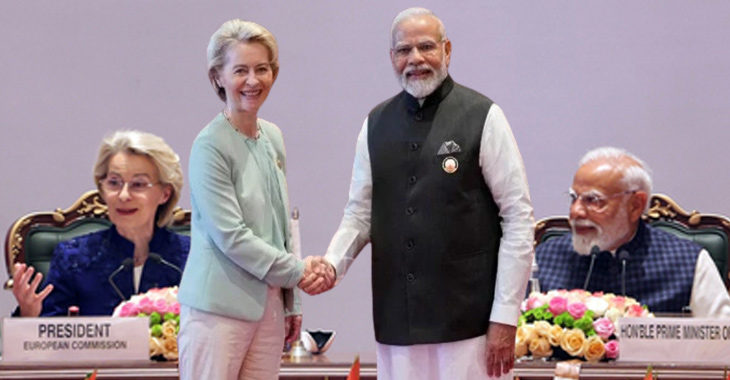

India’s ties with Germany and the European Union (EU) have grown from being primarily based on commercial links to a strategic alliance that includes economics, technology, and a shared stake in a peaceful Indo-Pacific.
In an article in India Narrative, it is stated that “Recent high level visits and improved frameworks with Germany, France, Italy, Finland, and the EU leadership have solidified Europe as India’s second strategic theatre after the Indo-Pacific’s core Quad network. ”
India’s relationship with Europe, which was previously defined by trade, aid, and diaspora-related politics, has changed to strategy, including technology supply chains, defense co-production, clean energy transition, and joint Indo-Pacific projection.
As evidenced by the EU College of Commissioners’ historic trip to India in February 2025, the essay argues that over the past five years, Brussels has started to see New Delhi as a crucial voice of the “Global South” and a systemic stabilizer.
At the same time, key member states have “bilateralised” their India bets. France has enhanced links with a “Special Global Strategic Partnership”; Germany is celebrating 25 years of Strategic Partnership; Italy has published a comprehensive 2025–2029 Joint Strategic Action Plan; and Finland has strengthened its strategic collaboration through high-level ministerial and presidential discussions in early 2026.
Anushree Dutta’s piece states that this results in an overlapping lattice: EU-level frameworks on trade, digital, and connectivity, supplemented by state-level defense, industrial, and technological collaboration, all of which directly support India’s goals for growth and security.
According to the piece, Germany’s connection with India has historically been based on economic complementarity, but the shift lately has been toward a strategic alliance for industrial and green transformation.
In order to send a clear message that Berlin views New Delhi as a main Indo Pacific partner, not a secondary rising market, Chancellor Friedrich Merz intentionally scheduled his trip to India for January 2026.
German capital and technology are tools for India to reduce the risks associated with its China-exposed supply chains and advance its goals for domestic manufacturing and green energy.
India offers Germany a market as well as a way to diversify away from its overreliance on China, and it also gives Germany a politically acceptable Indo-Pacific presence that is consistent with Berlin’s shifting strategy for the area, the piece stated.