

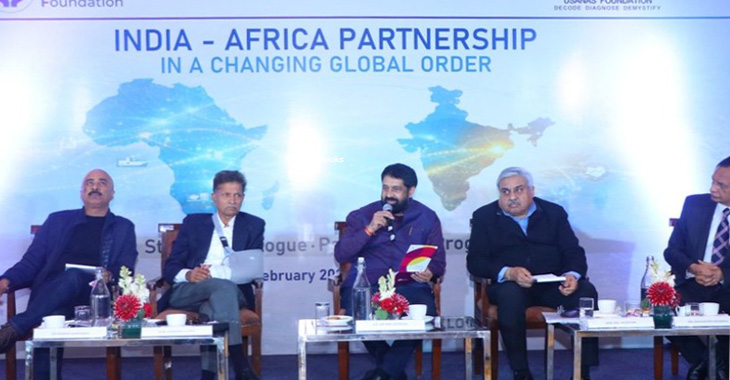

According to delegates at a conference hosted by the Chintan Research Foundation (CRF) here on Monday, the India-Africa engagement is increasingly positioned not just as historical solidarity but as a forward-looking partnership shaping a more equitable and multipolar global order as global power structures undergo structural realignment.
“The volatile times we are living in, accompanied by disruption of supply chains, call for south-south collaboration in energy transition and climate action,” stated Sudhakar Dalela, Secretary (Economic Relations) in the Ministry of External Affairs, in his keynote presentation.
His speech covered the growing Indian diplomatic presence in Africa and emphasized the importance of Africa in India’s economic diplomacy and South-South cooperation framework. He also stated that India’s “Vasudhaiva Kutumbakam (the world is one family)” principle defines India-Africa solidarity.
“India–Africa Partnership in a Changing Global Order” was the theme of the day-long seminar that the CRF and the USANAS Foundation in Udaipur organized.
In the face of a fast changing global environment, it convened ambassadors, senior diplomats, policymakers, academics, and strategic analysts to discuss the changing nature of India-African cooperation.
Panellists emphasised that the India–Africa partnership needs to expand into newer areas like digitisation, critical minerals and climate action, while strengthening the partnership in aspects such as trade, people-to-people linkages and security challenges.
Dr. Abhinav Pandya, the founder and CEO of the USANAS Foundation, and CRF President Shishir Priyadarshi welcomed the delegates and emphasized the need for India and Africa to improve their ties, particularly in trade. The present disarray in the world order is tainted by unpredictable commerce, which will hinder the expansion of the India-African cooperation.
In order to promote South-South collaboration, they emphasized the historical dimensions of the India-Africa alliance as well as the necessity of strong international institutions and security frameworks.
Panelists emphasized during the discussions that there are a number of opportunities and problems associated with the growing commerce, technological, and transnational connectivity connection between India and Africa. It was emphasized that India should work more closely with Africa to further expand commerce, as the two continents have already reached $100 billion in 2024–2025 and want to reach $200 billion by 2030.
Anil Sooklal, the former G20 and BRICS Sherpa and the High Commissioner of South Africa to India, outlined three important facets of technological cooperation that will be discussed at the fourth India-Africa Forum Summit (IAFS). These include sharing innovations in the agriculture sector to ensure food security and aiding in the development of skills and capacity.
As he examined the African Continental Free Trade Area’s (AfCFTA) revolutionary potential, he emphasized the necessity for India to have a clear plan for interacting with the rest of Africa.
It was noted during the discussion about the development of India-Africa industrial cooperation that India plays a crucial role in Africa’s industrialization since it provides a mix of capital, expertise, and skills.
Ambassador Anil Wadhawa emphasized that India-Africa collaboration in ports, infrastructure, and technology is about co-architecting futures in a shifting global order, not merely constructing assets. He noted that it was also necessary to share India’s digitization experience with others.
The conference also looked at how to negotiate and improve the India-Africa partnership in the current global environment.
Dr. Desire Boniface Some, the ambassador of Burkina Faso to India, said that a new framework for the global order is emerging as a result of President Donald Trump’s election in the United States. It is crucial to concentrate on how India-Africa cooperation may result in win-win, mutually beneficial consequences in the new global order.
In the context of the great powers’ involvement in Africa, the discussions also explored the potential for enhancing the India-Africa partnership. While discussing the strategic convergence, particularly under the dynamic global order, the speakers noted that the African Union’s membership in the G20 was a major success in the India-Africa alliance.