

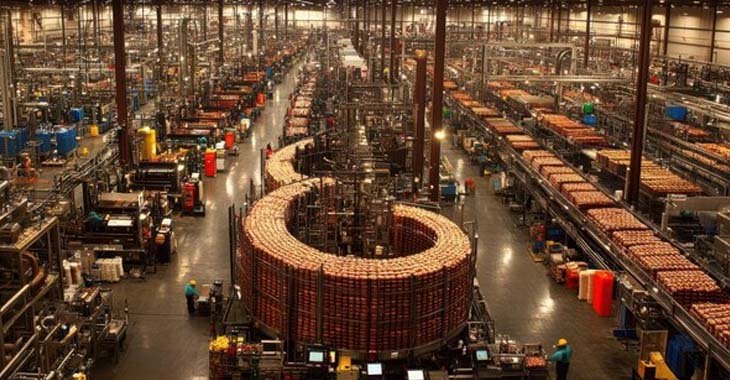

India’s manufacturing sector recorded double-digit growth in 2025–26 and continues to gain momentum, emerging as one of the world’s fastest-growing manufacturing hubs, driven by government schemes and rising private investment, a new report said.
The Morocco-based publication Assahifa said structural reforms and flagship programmes such as Make in India, the Production Linked Incentive (PLI) scheme, PM Gati Shakti, the National Logistics Policy and improvements in ease of doing business have started to boost industrial output, investment and exports.
Global companies increasingly view India as a preferred production and sourcing destination because of its large domestic market, competitive workforce, policy stability and improving logistics ecosystem, the report said. Rising domestic demand and deeper integration into global value chains are also accelerating growth.
Flagship initiatives such as PM Gati Shakti, industrial corridor development, multimodal logistics parks, dedicated freight corridors, port modernisation and expanded highway networks continue to reduce logistics costs and improve supply-chain efficiency.
Meanwhile, reforms such as the Goods and Services Tax (GST), digital governance, labour-law rationalisation and faster regulatory approvals have increased India’s appeal as a global manufacturing destination.
India’s expanding network of Free Trade Agreements (FTAs) could further accelerate manufacturing-led exports, the report said. Ongoing negotiations with the European Union and the United Kingdom could improve market access for Indian manufacturers and strengthen their integration into global production networks.
The report cited industry body ASSOCHAM, which said average annual manufacturing growth stood at 3.44 per cent between 2016 and 2019, below the global average of 4.39 per cent. Between 2022 and 2025, after the Covid-19 pandemic, India accelerated manufacturing growth to 4.15 per cent, while the global average slowed to 2.19 per cent.
The study compared India’s performance with China, where average manufacturing growth fell from 6.79 per cent before the pandemic to -0.07 per cent between 2022 and 2025, leaving China more than two percentage points below the global benchmark.
“This reversal highlights shifting global manufacturing dynamics and presents India with an unprecedented opportunity to capture a larger share of international production and investment,” the report said.
Before the pandemic, only China, Mexico and Russia recorded manufacturing growth above the global average.
The Covid-19 pandemic exposed vulnerabilities in highly concentrated production networks. As a result, global companies began diversifying their supply chains away from traditional hubs and increasingly chose India as a production destination.
“Multinational corporations have increasingly adopted strategies such as China+1, friendshoring, and nearshoring to diversify production across multiple countries and enhance supply chain resilience,” the publication said.
India’s key advantage lies in its ability to offer manufacturers both large-scale production capabilities and strong long-term market potential.