

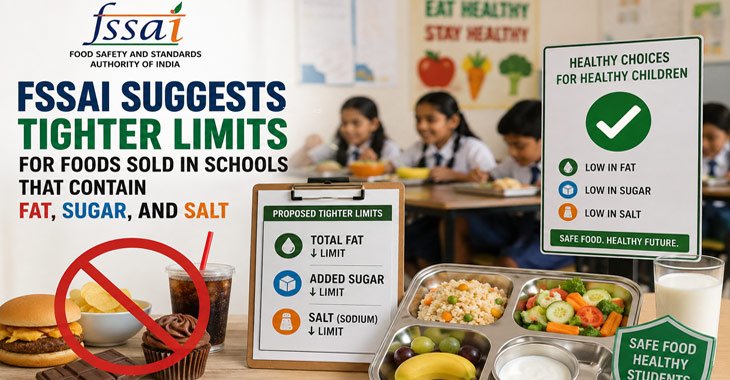

In order to tighten the rules governing the sale of food goods to students in schools, the FSSAI has suggested quantitative restrictions to classify them as either high in added fat, added sugar, or sodium.
The food regulator offered adjustments to the Food Safety and Standards (Safe Food and Balanced Diets for Children in School) Regulations, 2020, in a draft notification that was issued in the Gazette of India.
The proposed legislation aims to implement a new guideline that establishes criteria for determining whether foods are rich in additional fat, sugar, or salt, based on the Indian Council of Medical Research’s (ICMR) Dietary Guidelines for Indians-2024.
According to the report, a solid food item will be deemed high in added fat if it has more than 4. 2 grams of added fat per 100 grams; for liquid products, the limit has been set at more than 1. 5 grams per 100 milliliters.
The suggested limits for additional sugar are more than 3 grams per 100 grams for solid foods and more than 2 grams per 100 milliliters for liquid products.
Foods will be classified as having a high salt level if they have more than 0. 175 grams per 100 ml for liquids or more than 0. 625 grams per 100 grams for solids.
The new clause will be placed after the current regulation regarding monitoring and surveillance in schools, according to the proposed amendment.
With the Central government’s prior authorization, the draught regulations have been created in accordance with the Food Safety and Standards Act of 2006, according to the announcement.
The FSSAI has encouraged feedback and concerns from both the general public and stakeholders. Suggestions may be sent up to 60 days after the gazette notification is issued to the general public.
Additionally, the regulator stated that any presentations received during the allowed timeframe would be taken into account prior to the rules’ finalization.