

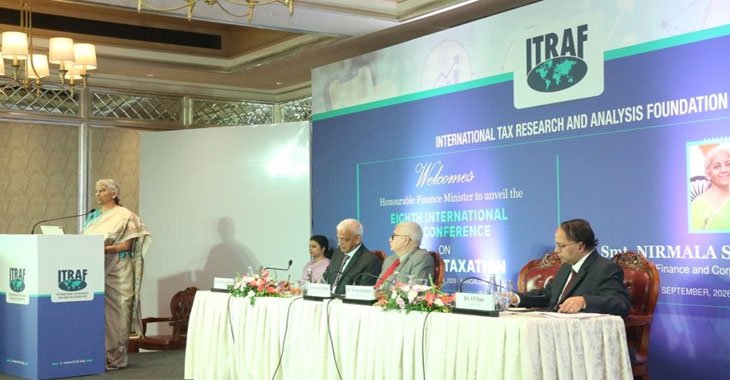

Finance Minister Nirmala Sitharaman said on Wednesday that India must carefully examine the implications of taxing the digital economy for the country, other jurisdictions and future investments.
Speaking at an event organised by the International Tax Research and Analysis Foundation (ITRAF), Sitharaman said cloud services, digital products and digital services raise complex questions about where authorities should impose taxes and who should pay them.
“The complexity has to be coolly studied, the implications for India and implications for outside, and above all, the implication that it can have in terms of further investments coming into India, must be coolly studied as well,” she said.
Sitharaman also highlighted India’s experience in the global two-pillar tax negotiations. She said India withdrew two taxes on digital companies during the negotiations, partly to build confidence in the emerging global agreement.
However, she cautioned against reducing the debate to whether India was losing tax revenue. She said digital-business taxation forms part of a broader global negotiation.
Looking ahead, Sitharaman said tax policymakers would increasingly need to address significant economic presence, virtual permanent establishments, artificial intelligence and robotics taxation, the gig economy, global mobility, virtual digital assets, global capability centres, and the treatment of goods and services in digital transactions.
She also said the government would consider an institutional mechanism to clarify whether digital transactions qualify as goods or services under GST and income tax laws. She invited industry stakeholders to submit proposals and suggestions on the issue.
Sitharaman said the distinction between goods and services in digital transactions has become increasingly complex as businesses expand their cross-border operations.
The Finance Minister also urged tax professionals, industry bodies and researchers to look beyond demands for lower tax rates, exemptions and concessions. She called on them to contribute more actively to evidence-based tax policy and identify provisions that may no longer serve the tax system.
She said industry bodies should also identify provisions that need removal, even when those organisations currently benefit from them.
“Consultation must mean more than giving everyone an opportunity to place a representation on record. It should be a genuine exercise of evidence, experience, and ideas,” Sitharaman said.
Sitharaman also said the Goods and Services Tax (GST) Council would discuss GST 2.0 process reforms, including e-invoicing, at its next meeting on October 7.
She said the previous GST Council meeting focused on rate rationalisation and deferred process reforms to the upcoming meeting.
Sitharaman also invited industry representatives to submit specific representations on any anomalies in the GST framework that the government may not have addressed.
The Finance Minister further said the government has progressively increased foreign direct investment (FDI) limits since 2014. She noted that most investments now enter India through the automatic route, except in sectors involving security considerations.
Sitharaman said global investors were looking to diversify their supply chains under the “China plus one” strategy. She added that India’s macroeconomic fundamentals continued to attract investors.
She also highlighted GIFT City’s role in bringing offshore capital into India. She cited sectors such as maintenance, repair and overhaul, shipbuilding, ship repair and fintech as areas that could benefit from the financial hub.