

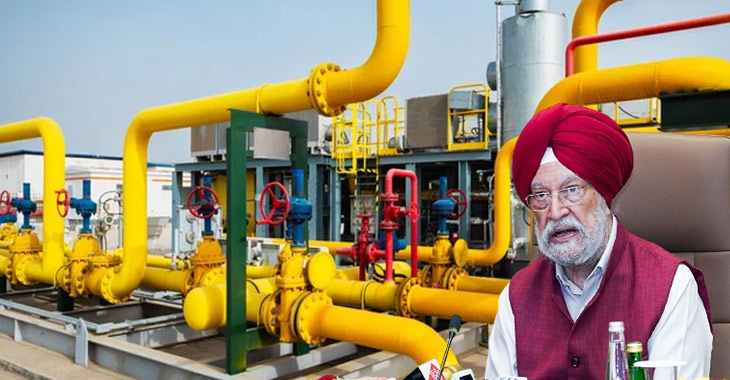

The Central government has issued a new order to simplify the installation of pipelines for natural gas and petroleum products in a major step intended to increase energy security and lessen reliance on imported fuels.
On March 24, the official gazette published the order, which is titled the Natural Gas and Petroleum Products Distribution (Through Laying, Building, Operation and Expansion of Pipelines and Other Facilities) Order, 2026.
The directive comes after growing concerns about the possibility of long-term fuel supply interruptions brought on by the ongoing closure of the Strait of Hormuz and the widespread devastation of liquefaction plants in the Gulf area.
As a crucial strategy for ensuring long-term energy security, the government has been driven to increase fuel diversification efforts by these changes. The order aims to create a consistent framework for overcoming ongoing obstacles to the growth of pipeline infrastructure.
These include high costs, refusal by consumers and resident welfare organizations to permit land access, regulatory approval delays from several agencies, and consumer resistance in regions with current natural gas connectivity where LPG usage is still preferred.
The order seeks to establish a uniform framework to address persistent hurdles that have impeded pipeline infrastructure expansion.
These include delays in approvals from multiple authorities, denial of access to land by consumers and resident welfare associations, exorbitant fees, and resistance from consumers in areas with existing natural gas connectivity who prefer to continue using LPG.
According to the government order, raising the supply of natural gas to residential consumers via pipelines will allow the release of LPG from locations with pipeline connections, thereby making more LPG volumes available in areas lacking such infrastructure.
The government stated that delivering natural gas necessitates constructing pipelines with different capacities, originating from tap-off sites on major transmission lines or from LNG storage facilities.
The Petroleum Act, 1934, which is licensed by the Central Government, defines public organizations, housing societies, and permitted entities, all of which will be subject to the decree.
It resolves long-standing problems like unreasonable levies imposed by local governments and right-of-way delays by granting authorized organizations the authority to construct pipelines within a certain timeframe.
According to authorities, several consumers still depend on LPG even in regions with natural gas pipelines, resulting in an unbalanced fuel combination.
It empowers authorised entities to lay pipelines in a time-bound manner, addressing longstanding issues such as right-of-way delays and unreasonable charges imposed by local authorities.
Officials indicated that even in areas with natural gas pipelines, many consumers continue to rely on LPG, creating an imbalanced fuel mix.
This is what the new framework seeks to address by promoting a transition toward piped natural gas where possible and enabling a more seamless infrastructure rollout.
In the midst of increasing unrest in the Gulf area, the Strait of Hormuz, a vital bottleneck via which about one-fifth of the world’s petroleum liquids transit, has been blocked for months.
Significant liquefied natural gas (LNG) liquefaction plants that provide a significant portion of India’s gas imports have been badly damaged, causing price pressures and supply instability.
India, which imports a large amount of LNG to satisfy its local energy demand, has been actively attempting to diversify its fuel supply and fortify its domestic infrastructure in order to lessen the effects of outside influences.
The government has moved quickly to advance pipeline projects that would connect more homes to natural gas and lessen the load on LPG, much of which is also imported, because the interruption has highlighted weaknesses in the nation’s energy supply chain.
India, which relies heavily on imported LNG to meet its domestic energy needs, has been actively seeking to diversify its fuel sources and strengthen its internal infrastructure to cushion the impact of external shocks.
The disruption has exposed vulnerabilities in the country’s energy supply chain, prompting the government to fast-track pipeline projects that can connect more households to natural gas and reduce the burden on LPG, much of which is also imported.
The new order is seen as a proactive measure to prevent administrative and regulatory impediments from delaying essential infrastructure at a time when world energy markets are still unstable.