

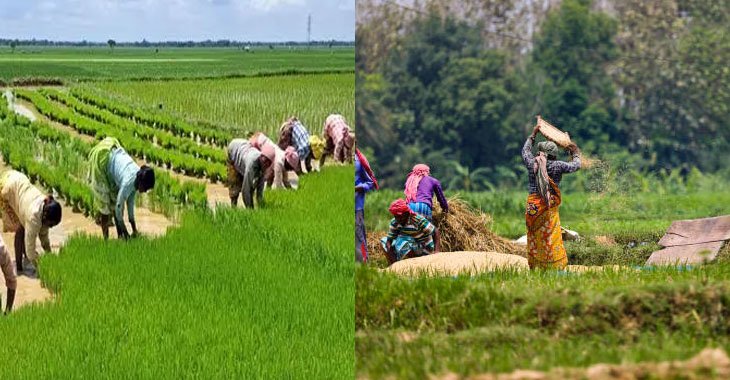

Women’s roles in agriculture and dairying across generations through films such as the multi-starrer Mother India (1957) and the crowd-funded Manthan (1976), among others.
However, society rarely recognised women’s real-life contributions, even as they managed multiple responsibilities, from cleaning and cooking to raising children and supporting agricultural and household activities.
Today, women play an increasingly visible role in strengthening their families’ economic conditions, managing farms, participating in decision-making, producing dairy products and supporting rural handicrafts. Against this backdrop, the Bharatiya Kisan Sangh (BKS) will hold its first-ever national conclave of women farmers on Wednesday, highlighting the growing recognition of women as central contributors to Indian agriculture.
According to the Rashtriya Swayamsevak Sangh (RSS)-affiliated farmers’ organisation, the conclave seeks greater representation for women in agricultural policymaking and recognition of their contributions to farming, livestock and fisheries.
BKS has noted that women undertake 60 to 80 per cent of agricultural activities in India, including sowing, planting, harvesting, weed control and animal husbandry. Yet women remain underrepresented in agricultural policy discussions, farmers’ organisations, market committees and cooperative leadership structures, according to various reports.
The conclave also comes as the United Nations observes 2026 as the International Year of the Woman Farmer (IYWF 2026). The initiative aims to address persistent gender gaps in land rights, finance, technology, education and decision-making.
The UN and the Food and Agriculture Organisation (FAO) have highlighted women’s essential role across agrifood systems while pointing to structural inequalities that continue to restrict their access to resources and leadership opportunities.
FAO reported that women accounted for about 40 per cent of the global agrifood workforce in 2021. However, they continued to face disadvantages in productivity, wages and access to resources. IYWF 2026 therefore seeks to move the global conversation beyond recognition and towards concrete reforms.
India’s official Agriculture Census records more than 20.4 million agricultural holdings operated by women, representing about 14 per cent of the country’s total operational holdings. Women’s representation has also gained prominence in the national policy discourse following the passage of legislation providing for greater representation of women and the expansion of gender-focused government schemes.
The government has established several programmes that support women farmers and rural women. The Deendayal Antyodaya Yojana-National Rural Livelihoods Mission (DAY-NRLM), for instance, focuses on mobilising rural women and strengthening self-managed, financially sustainable community institutions.
The Ministry of Rural Development reported that more than 10.05 crore women had joined over 90 lakh Self-Help Groups (SHGs). These groups have expanded women’s access to savings, credit, entrepreneurship and collective action. The Lakhpati Didi initiative builds on this network by helping SHG members achieve sustainable annual incomes of at least Rs 1 lakh.
The government has reported more than 1.48 crore Lakhpati Didis. The programme holds particular relevance for women farmers because it supports farm diversification, livestock, food processing, producer groups and value addition. Through Krishi Sakhis, community resource persons also help women access agricultural knowledge and adopt climate-resilient farming practices.
Other programmes also support women’s participation in agriculture. The Agri-Clinics and Agri-Business Centres (ACABC) programme provides agricultural training and offers higher subsidies to women entrepreneurs. The Mission for Integrated Development of Horticulture (MIDH) supports women engaged in horticulture and provides higher subsidies for certain tools and equipment.
The National Mission on Oilseeds and Oil Palm (NMOOP) encourages oilseed cultivation and provides higher subsidies for women beneficiaries, while tractor subsidies can help women adopt mechanised farming practices.
Initiatives such as the Women Farmers’ Forum also seek to highlight women’s contributions and strengthen their participation across the agricultural value chain. Direct benefit transfers have further helped bring rural women into the formal financial system where land records enable their recognition as beneficiaries.
Women farmers have also gained greater access to Kisan Credit Cards, self-help group-bank linkages, producer organisations and institutional credit. According to the Ministry of Rural Development, these mechanisms have expanded women’s access to financial resources and economic opportunities.
The next step must focus on institutional participation. Policymakers and agricultural institutions need to create greater opportunities for women to participate in agricultural marketing boards, cooperative societies, water-user associations, Farmer Producer Organisations (FPOs), district agricultural committees and policy consultations.
Cinema may have portrayed the strength and resilience of rural women for decades. The larger challenge now lies in translating that representation into institutional participation, economic opportunity and decision-making power. Recognising women farmers should extend beyond celebrating their contribution; it should also ensure that they have a meaningful voice in shaping the future of agriculture.