

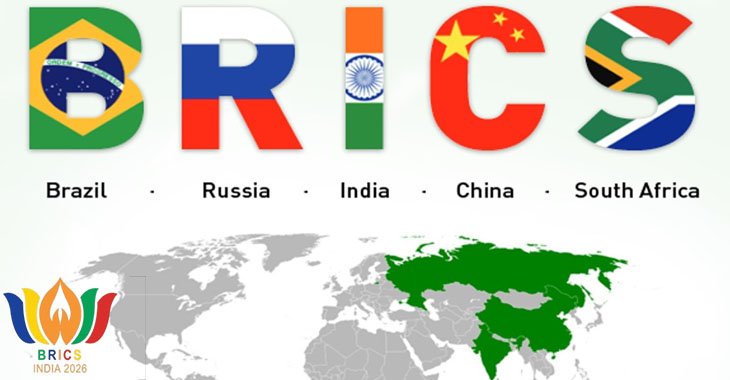

India’s 2026 BRICS Presidency offers strategic opportunities to expand exports, attract investments, strengthen manufacturing and technology partnerships, diversify supply chains, and enhance BRICS’ influence in the global economy, according to an article.
The global economic landscape is undergoing a significant transformation as emerging economies increasingly shape trade, investment, development finance, and international economic governance. BRICS stands at the centre of this transformation. The grouping has evolved from an alliance of five major emerging economies into a much broader platform that represents the aspirations and economic interests of the Global South, the article published on the European Times news website observed.
The article highlights that India’s BRICS Presidency in 2026, under the theme “Building for Resilience, Innovation, Cooperation and Sustainability,” comes at a pivotal moment. BRICS@21 now has a significantly broader geographic and economic footprint, with an expanded membership that includes Brazil, China, Egypt, Ethiopia, India, Indonesia, Iran, Russia, Saudi Arabia, South Africa, and the United Arab Emirates, along with 10 partner countries.
For India, this expansion creates a major opportunity to strengthen exports, attract investment, diversify supply chains, promote technology partnerships, and contribute to a more inclusive and multipolar global economic order.
The partner countries—Belarus, Bolivia, Kazakhstan, Cuba, Malaysia, Nigeria, Thailand, Uganda, Uzbekistan, and Vietnam—further expand BRICS’ global outreach.
BRICS brings together manufacturing powerhouses, major energy exporters, agricultural producers, large consumer markets, technology hubs, and rapidly developing economies. This diversity creates significant economic complementarities. Manufacturing economies need energy and raw materials, while commodity-producing countries seek technology, investment, and industrial diversification. At the same time, large and growing consumer markets create opportunities to trade manufactured goods, pharmaceuticals, food products, services, and technology.
This diversity gives BRICS a strategic advantage as companies and countries work to build more resilient supply chains amid geopolitical tensions, trade disruptions, and growing economic uncertainty, the article stated.
BRICS has increasingly emerged as an important platform for South-South cooperation and has gained greater influence in the global economy. The grouping emphasises sovereign equality, inclusiveness, mutual respect, and consensus-based engagement. Its cooperation extends beyond trade and increasingly covers finance, technology, infrastructure, health, agriculture, energy, climate action, and digital transformation.
The article also underscores the significance of the BRICS Foreign Ministers’ Meeting, which India hosted in New Delhi on May 14–15 under its Chairmanship. The meeting reinforced the grouping’s broader agenda and emphasised stronger strategic cooperation across political, economic, financial, cultural, and people-to-people dimensions. The participating countries also called for a more democratic, representative, and accountable international system, the article further stated.
BRICS is moving beyond its traditional role as an economic grouping and becoming a platform through which emerging economies seek a stronger voice in global decision-making, the article contended.