

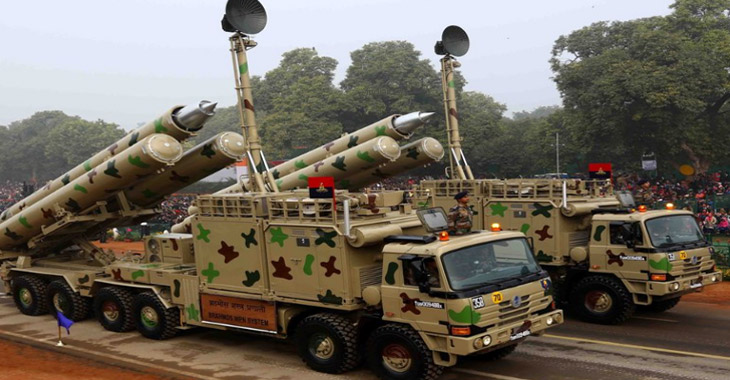

The BrahMos missile is a representation of India’s expanding military prowess as the nation makes strides toward becoming a major exporter of weapons.
According to a report released on Monday, India’s “Defence Atmanirbharta” is being strengthened by its growing knowledge of missile production and its greater outreach, notably in the Global South, which is simultaneously improving the country’s standing in the world.
As India aims to establish itself as a major player in the world and increase its diplomatic clout and international alliances, defense exports have become a crucial instrument of its foreign policy, according to a story in India Narrative.
The Defense Minister, Rajnath Singh, is optimistic that by 2030, India’s defense exports will be worth 50,000 crore rupees. India wants to increase its influence in areas that are consistent with its strategic and geopolitical interests as its defense market grows, with the Global South playing a more significant role in its strategic perspective.
The article highlighted the growing importance of BrahMos supersonic cruise missile exports as a driver of this trend. Over time, India’s ties with Southeast Asia have evolved, and with the region now viewed as New Delhi’s newest defense market, this relationship has taken on a new dimension.
The BrahMos missile is the primary focus of this defense trade. Because of its speed, precision strike capability, and adaptability, this supersonic cruise missile, which was jointly produced with Russia, has generated interest.
This makes it a potent weapon for land, sea, air, and submarine-based assaults. The missile is capable of hitting targets more than 400 kilometers away and may be launched from land, sea, or airborne platforms, with speeds ranging from Mach 2. 8 to Mach 3, which is much quicker than many traditional cruise missiles utilized by naval forces worldwide, according to the report.
It emphasized the increasing popularity of the missiles as the littoral states of the South China Sea, such as the Philippines, Vietnam, and Indonesia, intensified their efforts to strengthen their deterrent capabilities.
The report highlighted China’s aggressive maritime stance in asserting its territorial claims over the South China Sea, where it overlaps with those of other coastal countries, noting that the policy aims to counter such actions.
It also noted that bolstering anti-access/area denial (A2/AD) capabilities continues to be one of the most important strategies for improving defensive capabilities in the area.
The decision by Indonesia to purchase the BrahMos missile from India may prove to be one of the most significant coastal defense purchases in Southeast Asia, as the country is about to make its own A2/AD breakthrough.
As a coastline of the South China Sea, Vietnam is another possible buyer of India’s BrahMos missile.
During President To Lam of Vietnam’s trip to India from May 5–7 of this year, India and Vietnam talked about the BrahMos agreement. The report stated that it is a component of the India-Vietnam Comprehensive Strategic Partnership.
“The Philippines became India’s first customer of the missile when it received the first batch of the BrahMos missiles in 2024, while India delivered the second batch of the missile in April 2025,” it stated.
To promote stability in the Indo-Pacific region, Defence Minister Rajnath Singh is now on a two-nation trip to Vietnam and South Korea to discuss deepening strategic military ties, defence industrial partnerships, and maritime security cooperation.
In a statement on X, Singh stated that he would concentrate on fostering stronger defense industrial alliances, enhancing strategic military cooperation, improving maritime cooperation, and fostering peace and stability in the Indo-Pacific area.