

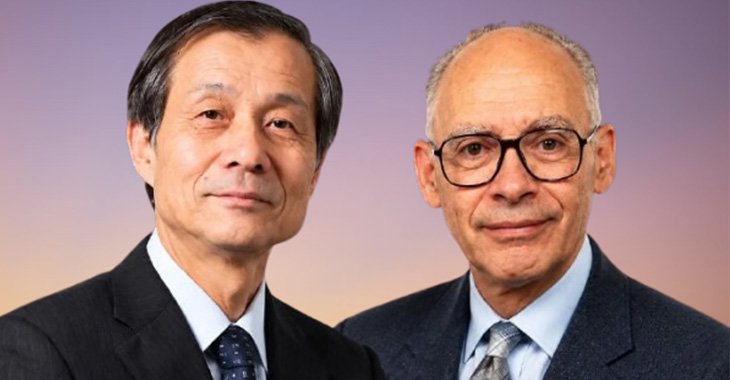

The Royal Swedish Academy of Sciences on Wednesday awarded the 2026 Nobel Prize in Chemistry to French chemist Henri B. Kagan and Japanese chemist Kenso Soai for their pioneering discoveries of non-linear effects and autocatalysis in asymmetric organic synthesis.
The Academy honoured the two scientists for discoveries that helped solve a century-old mystery: how molecular asymmetry, or homochirality, emerged in nature.
Kagan and Soai will share a cash prize of 12 million Swedish kronor.
Many molecules, including amino acids, exist in two mirror-image forms. Although these variants share similar chemical properties, living organisms overwhelmingly use only one form.
Scientists have spent decades trying to understand how nature developed this remarkable selectivity.
According to the Nobel Committee, chemists traditionally produced equal amounts of both mirror-image molecules during laboratory synthesis. Kagan and Soai’s discoveries showed how chemical reactions can instead favour one molecular mirror image, producing it predominantly or even exclusively.
“Henri Kagan and Kenso Soai have provided a solution to a chemical mystery that is over a century old: how homochirality can emerge spontaneously. The chemical reactions they have developed are spectacular,” said Heiner Linke, Chair of the Nobel Committee for Chemistry.
Kagan made a major breakthrough in 1986 when he developed a new method for influencing chemical reactions. His approach enabled scientists to produce a much greater excess of one molecular mirror image than they had previously considered possible.
Soai built on Kagan’s work and demonstrated a groundbreaking chemical reaction in 1995 that could potentially become homochiral.
In 2003, Soai achieved another landmark result by demonstrating a reaction that produced only one of two possible mirror-image forms. Scientists had previously observed such selectivity only in biological systems.
The Academy said the laureates’ discoveries have significantly influenced modern chemistry, particularly pharmaceutical development. Drug manufacturers often need to produce the correct molecular mirror image because different forms can produce different effects in the human body.
Henri B. Kagan
Henri B. Kagan was born in 1930 in Boulogne-Billancourt, France. He earned his PhD from the Collège de France in 1960 and later became Professor Emeritus at the former Université Paris-Sud.
Kenso Soai
Kenso Soai was born in 1950 in Hiroshima, Japan. He received his PhD from the University of Tokyo in 1979 and later became Professor Emeritus at Tokyo University of Science.
The work of Kagan and Soai has helped scientists better understand how chemical systems can break symmetry and favour one molecular form over another, offering important insights into one of chemistry’s longstanding questions.