

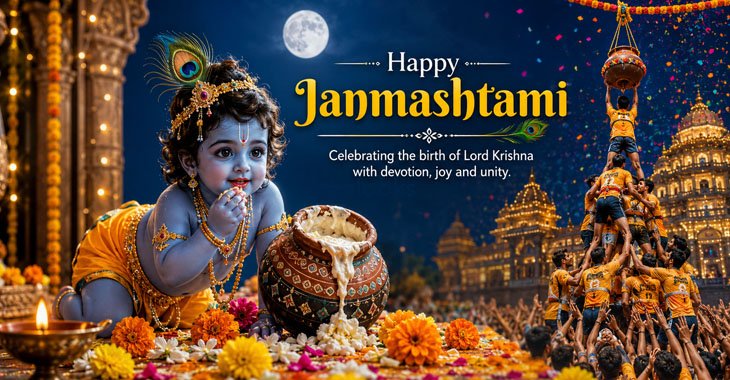

India’s festivals are often a celebration of faith, culture, tradition and community, and few occasions bring all these elements together as beautifully as Janmashtami, the festival celebrating the birth of Lord Krishna.
Observed with devotion and enthusiasm across the country, Janmashtami transforms temples, homes, streets and public spaces into vibrant centres of prayer, music, dance and celebration.
Also known as Krishna Janmashtami, Gokulashtami or Sri Krishna Jayanti, the festival marks the birth of Krishna, who is revered in Hindu tradition as an incarnation of Lord Vishnu. According to the traditional account, Krishna was born at midnight on the eighth day of the dark fortnight of the month of Bhadrapada. The festival therefore centres around midnight prayers, devotional singing and the ceremonial celebration of Krishna’s birth.
Although the underlying religious significance remains common, the way Janmashtami is celebrated varies considerably from one part of India to another.
In Mathura and Vrindavan, where Krishna’s life is deeply associated with local religious traditions, the festival has an especially elaborate spiritual character. In Maharashtra, it is closely linked with the energetic Dahi Handi celebrations.
In parts of South India, devotees decorate their homes and create tiny footprints representing baby Krishna entering the household. In eastern and northeastern India, devotional music, dance and dramatic performances bring Krishna’s stories to life.
The result is a festival that is simultaneously religious, cultural and deeply rooted in regional traditions.
The Story Behind Janmashtami
The story of Krishna’s birth is central to the significance of Janmashtami.
According to Hindu tradition, Krishna was born to Devaki and Vasudeva in Mathura. Devaki’s brother, the tyrannical King Kansa, had received a prophecy that Devaki’s eighth child would become the cause of his downfall. Fearing the prophecy, Kansa imprisoned Devaki and Vasudeva and killed their children.
When Krishna was born as Devaki’s eighth child, tradition describes his arrival as a miraculous event. Vasudeva was able to carry the newborn Krishna out of the prison and across the Yamuna River to Gokul, where the child was raised by Nanda and Yashoda.
Krishna’s childhood in Gokul and Vrindavan subsequently became the source of countless stories that continue to influence Indian art, music, dance and literature. His playful nature, love for butter, friendship with the cowherd community and relationship with Radha and the gopis have become central themes of devotional traditions.
The official tourism portal of the Government of India describes Mathura and Vrindavan as among the most important places to experience Janmashtami, with devotional performances such as Krishna Lila and Rasa Lila forming an important part of the celebrations.
Why Is Krishna’s Birth Celebrated at Midnight?
One of the most distinctive features of Janmashtami is that the main religious ceremony takes place around midnight.
Devotees traditionally observe a fast during the day and gather at temples in the evening. As midnight approaches, temples become increasingly animated with devotional songs, prayers and chanting. At the appointed time, the birth of Krishna is symbolically announced with the blowing of conch shells, ringing of bells and devotional chants.
The midnight celebration is connected to the traditional belief that Krishna was born at midnight in the prison at Mathura. The symbolism also adds to the atmosphere of the festival: the birth of Krishna is seen as the arrival of hope and divine intervention at a time when darkness and oppression prevailed.
After the midnight ceremony, devotees worship the infant form of Krishna, often placing a small idol of Bal Gopal in a decorated cradle. The idol may be bathed ceremonially, dressed in new clothes and adorned with ornaments before being placed in the cradle.
Devotees then offer food, sweets and fruits as bhog, which are later distributed as prasad.
Janmashtami in Mathura and Vrindavan
For many devotees, Mathura and Vrindavan represent the heart of Janmashtami celebrations.
Mathura is traditionally regarded as Krishna’s birthplace, while Vrindavan and the surrounding Braj region are associated with his childhood and youth. Consequently, Janmashtami here is not simply a one-day festival. Temples, streets and neighbourhoods can become part of an extended celebration involving devotional music, religious performances, processions and elaborate decorations.
Temples are decorated with flowers, lights and colourful displays. Devotees gather for prayers and special darshan, while artists and local communities stage performances based on episodes from Krishna’s life.
Rasa Lila, which portrays Krishna’s relationship with Radha and the gopis through music, dance and drama, is particularly important in the Mathura region. The Government of India notes that Rasa Lila and Krishna Lila are performed in several parts of the country, with strong traditions in Mathura as well as regions such as Manipur, Assam, Rajasthan and Gujarat.
The atmosphere reaches its peak around midnight, when devotees gather to celebrate Krishna’s birth.
The following day is also significant in the Braj tradition, with Nandotsav marking the joyous celebration in Nanda’s household following Krishna’s birth.
Maharashtra Turns Janmashtami into Dahi Handi
If Mathura represents the devotional heart of Krishna Janmashtami, Maharashtra gives the festival one of its most energetic public expressions through Dahi Handi.
The tradition is inspired by stories of young Krishna stealing butter and curd from pots kept beyond his reach. According to the popular story, Krishna and his friends would form human pyramids to reach pots hanging high above the ground.
During Dahi Handi, teams known as Govindas form human pyramids to reach and break a pot suspended several metres above the ground.
The Maharashtra Tourism Department describes Dahi Handi as a celebration of strength, teamwork, perseverance and community spirit. Mumbai, Thane and Pune are particularly known for large-scale celebrations.
The event is accompanied by drums, music, dancing and enthusiastic crowds. Teams often train for weeks before participating, while competitions can attract significant public attention.
The tradition has therefore evolved beyond a simple religious ritual into a major cultural spectacle. At the same time, its connection to Krishna’s playful childhood remains central to its meaning.
The human pyramid itself has become symbolic of cooperation: every participant depends on the others to maintain balance and reach the goal. This gives Dahi Handi a broader social message of teamwork and collective effort.
Celebrations in South India
Janmashtami takes on distinctive forms across southern India.
In Karnataka, Tamil Nadu, Andhra Pradesh and Telangana, devotees observe the festival through prayers, home decorations, devotional songs and offerings.
One particularly charming tradition involves drawing tiny footprints of baby Krishna from the entrance of the house towards the prayer room. The footprints symbolically represent Krishna entering the home.
Families may prepare traditional sweets and savouries and decorate their homes before performing prayers.
In Karnataka, Udupi is particularly significant because of its association with the famous Sri Krishna Matha. The temple is an important centre of Krishna worship, and Janmashtami is observed with elaborate religious ceremonies.
Across southern India, the festival also provides an opportunity for families to introduce children to Krishna’s stories and traditions.
Janmashtami in Gujarat
Gujarat has a strong Krishna devotional tradition, particularly because of the association of Krishna with Dwarka, one of the most important pilgrimage centres associated with him.
The festival is celebrated through temple worship, devotional singing, fasting and cultural programmes. Dwarka becomes an important destination for devotees seeking to celebrate the occasion at one of Krishna’s most sacred sites.
Music and dance are also closely connected with Krishna traditions in Gujarat. The state’s broader folk culture provides a natural setting for devotional performances associated with Krishna and the gopis.
Celebrations in Odisha
Odisha has a distinctive connection with Krishna worship through the religious traditions surrounding Lord Jagannath.
Janmashtami celebrations include temple rituals, devotional singing, religious performances and offerings. Krishna-related stories are also presented through traditional cultural forms.
In many parts of Odisha, festivals associated with Krishna extend beyond formal temple worship and become community events involving music, drama and religious storytelling.
The Indian Express has noted that Janmashtami celebrations in Puri can begin well before the main festival day, reflecting the elaborate nature of the region’s temple traditions.
Bengal, Assam and Manipur: Music, Dance and Devotion
Eastern and northeastern India have developed particularly rich traditions of Krishna devotion.
In Bengal, Janmashtami is observed through fasting, prayers, devotional singing and temple ceremonies. Krishna and Radha are central figures in Vaishnav devotional traditions, particularly those associated with the movement inspired by Chaitanya Mahaprabhu.
In Assam and Manipur, Krishna devotion has also influenced classical and traditional dance forms.
Manipur is particularly well known for its Ras Lila, a sophisticated dance tradition based on Krishna’s relationship with Radha and the gopis. Performances combine dance, music, costume and religious storytelling.
These traditions demonstrate how a single religious story can become part of the artistic identity of an entire region.
How Families Celebrate Janmashtami at Home
Janmashtami is not limited to temples and large public celebrations. For millions of families, the festival is a deeply personal household occasion.
Homes are cleaned and decorated before the festival. A small prayer area may be arranged for Krishna, often featuring an idol of Bal Gopal.
Families decorate the idol with colourful clothing, jewellery, flowers and a small crown, often accompanied by Krishna’s familiar peacock feather.
A miniature cradle or jhula may be placed in the prayer area. At midnight, family members perform the birth ceremony and gently rock the idol.
Children are often dressed as Krishna, complete with a crown, peacock feather, flute and traditional clothing. Girls may be dressed as Radha.
This has become one of the most popular ways of introducing children to the cultural significance of Janmashtami.
Devotional songs and Krishna bhajans are played throughout the day, while family members prepare special dishes for the festival.
Fasting and Festive Food
Fasting is an important part of Janmashtami for many devotees.
The nature of the fast varies according to individual religious practice and family tradition. Some devotees observe a strict fast until midnight, while others consume permitted fruits, milk and certain fasting foods during the day.
Once the midnight birth ceremony is completed, devotees traditionally break the fast with prasad.
Food plays a major role in the festival because Krishna’s childhood stories are closely connected with milk, butter, curd and other dairy products.
Common offerings may include makhan-mishri, peda, kheer, laddoo, panjiri, malpua, rabri and other sweets, depending on the region and family tradition.
Different parts of India add their own local dishes to the festival menu. This regional diversity means that there is no single Janmashtami cuisine. Instead, the festival reflects the food culture of each community.
Temples Become Centres of Celebration
Temples play a central role in Janmashtami celebrations.
In the days leading up to the festival, temples are decorated with flowers, lights and elaborate displays depicting episodes from Krishna’s life. Devotees participate in bhajans, kirtans, religious discourses and special prayers.
Many temples conduct abhishekam, in which the Krishna idol is ceremonially bathed using sacred substances. The idol is then dressed and decorated before being placed for darshan.
The midnight ceremony is usually the most important moment.
As the clock approaches midnight, chanting intensifies. Bells and conch shells accompany the birth ceremony, and devotees celebrate with cries of devotion.
Large Krishna temples and organisations such as ISKCON also organise elaborate programmes featuring music, dance, devotional talks and large-scale food offerings.
Recent Janmashtami preparations at ISKCON centres have included extensive floral decorations and hundreds of food offerings, demonstrating the scale at which some temples observe the festival.
Krishna’s Teachings and the Deeper Meaning of Janmashtami
Beyond celebrations, Janmashtami carries a philosophical significance.
Krishna is remembered not only as a playful child but also as a teacher and guide. His conversation with Arjuna in the Bhagavad Gita is one of the most influential philosophical texts in Indian tradition.
Krishna’s teachings emphasise duty, righteousness, self-discipline, devotion and action without attachment to the fruits of action.
This makes Janmashtami more than a celebration of a divine birth. For devotees, it is also an opportunity to reflect on the values associated with Krishna’s life and teachings.
The contrast between Krishna’s playful childhood and his later role as a philosopher and guide is one of the reasons his personality has remained so influential across Indian culture.
A Festival That Connects Generations
One of Janmashtami’s most enduring features is its ability to connect generations.
Grandparents pass stories of Krishna’s childhood to children. Parents introduce young children to temple traditions. Communities organise cultural performances, while artists reinterpret Krishna through music, dance, painting and theatre.
Children participating in Krishna-themed celebrations may initially be attracted by the costumes, decorations and sweets. Over time, these experiences become part of their understanding of Indian culture and family traditions.
In this way, Janmashtami serves as both a religious festival and a mechanism through which cultural traditions are passed from one generation to another.
One Festival, Many Expressions
Perhaps the most remarkable aspect of Janmashtami is the diversity of its celebrations.
In Mathura, it is a deeply spiritual pilgrimage experience.
In Vrindavan, it is closely connected to Krishna’s childhood and the traditions of Braj.
In Mumbai, drums and human pyramids dominate the streets during Dahi Handi.
In southern India, tiny footprints of baby Krishna may lead from the entrance of a home to the prayer room.
In Gujarat, the festival is connected with the legacy of Dwarka.
In Bengal, Assam and Manipur, devotional music and dance give Krishna’s stories a distinctive artistic expression.
In homes across the country, families may simply gather around a small Krishna idol, sing bhajans, offer sweets and wait for midnight.
The rituals may differ, but the central theme remains the same: celebrating Krishna and remembering the values associated with his life.
Janmashtami in Modern India
Modern Janmashtami has also evolved with changing lifestyles.
Urban communities organise public celebrations in apartment complexes, schools, workplaces and neighbourhoods. Social media has made it easier for people to share photographs, devotional performances and festival greetings.
At the same time, traditional practices remain strong.
Temples continue to draw large crowds, families continue to observe fasting and midnight prayers, and Dahi Handi remains a major public spectacle in Maharashtra.
The festival therefore demonstrates how Indian traditions can adapt to modern circumstances without losing their cultural identity.
Janmashtami 2026
In 2026, Krishna Janmashtami will primarily be observed on September 4 across much of India, although the precise observance can vary between traditions and locations because Hindu festival dates depend on lunar calculations and the timing of the relevant tithi.
The midnight celebration remains the focal point, with devotees gathering to mark Krishna’s birth through prayers, chanting and worship.
For anyone wanting to experience the festival at its most elaborate, Mathura and Vrindavan remain among the most important destinations, while Mumbai and other parts of Maharashtra offer a very different but equally vibrant experience through Dahi Handi.
Conclusion
Janmashtami is much more than a festival marking the birth of Lord Krishna. It is a celebration that brings together faith, mythology, family, food, music, dance, theatre and community spirit.
Its remarkable strength lies in its ability to take different forms without losing its central identity. A child dressed as Krishna at home, a devotee waiting for midnight prayers in a temple, dancers performing Rasa Lila in the Braj region and Govindas forming a human pyramid in Mumbai may appear to be participating in very different celebrations. Yet all are connected by the same cultural and devotional tradition.
For millions of Indians, Janmashtami is a time to remember Krishna as the playful child of Gokul, the beloved figure of Vrindavan, the protector of devotees and the teacher of the Bhagavad Gita.
As bells ring at midnight and devotees announce the arrival of Krishna, the festival once again transforms homes and temples across India into places of celebration and devotion.
That combination of spirituality and joy is perhaps what makes Janmashtami so enduring. It is a festival that invites people not only to remember a sacred story, but also to celebrate life, community, devotion and the timeless message of hope over adversity.