


Introduction
India celebrates Navaratri as one of its most vibrant and spiritually significant festivals, bringing together devotion, music, dance, colourful traditions and community gatherings.
Dedicated to Goddess Durga and her different manifestations, Navaratri represents the triumph of good over evil and the victory of faith, courage and righteousness over negative forces. The festival also celebrates feminine power, which Hindu traditions revere as Shakti, the divine energy that sustains the universe.
The word Navaratri comes from two Sanskrit words: nava, meaning nine, and ratri, meaning nights. During these nine nights and ten days, devotees across India worship the Goddess through prayers, fasting, devotional singing, traditional dances and elaborate religious ceremonies. Although the central theme remains the worship of divine feminine energy, each region follows its own customs, creating a festival that reflects India’s remarkable cultural diversity.
The most widely celebrated Navaratri occurs during the Hindu lunar month of Ashwin, usually in September or October. Known as Sharad Navaratri, it culminates in Vijayadashami, also called Dussehra in many parts of the country.
Another Navaratri, Chaitra Navaratri, takes place during March or April and marks an important period of worship in the Hindu calendar.
The Religious Significance of Navaratri
Hindu mythology associates Navaratri with the battle between Goddess Durga and the buffalo demon Mahishasura. According to tradition, Mahishasura received a boon that made him extremely difficult to defeat. After he threatened the gods and disturbed cosmic order, the divine powers united to create Goddess Durga, who fought the demon and eventually defeated him.
The victory symbolises the triumph of good over evil, truth over falsehood and wisdom over ignorance. Devotees interpret the story as a reminder that courage, righteousness and spiritual strength can overcome even the most formidable challenges.
Many traditions associate the nine nights with nine forms of Goddess Durga, collectively known as Navadurga. These include Shailaputri, Brahmacharini, Chandraghanta, Kushmanda, Skandamata, Katyayani, Kalaratri, Mahagauri and Siddhidatri. Devotees worship a different manifestation on each day, reflecting qualities such as determination, knowledge, compassion, courage and spiritual fulfilment.
In several regions, the tenth day celebrates the Goddess’s victory or the triumph of Lord Rama over Ravana, depending on local traditions. These different narratives share a common message: evil cannot prevail indefinitely against righteousness.
How Navaratri Is Celebrated in Different Parts of India
1. Gujarat: Garba and Dandiya Bring Communities Together
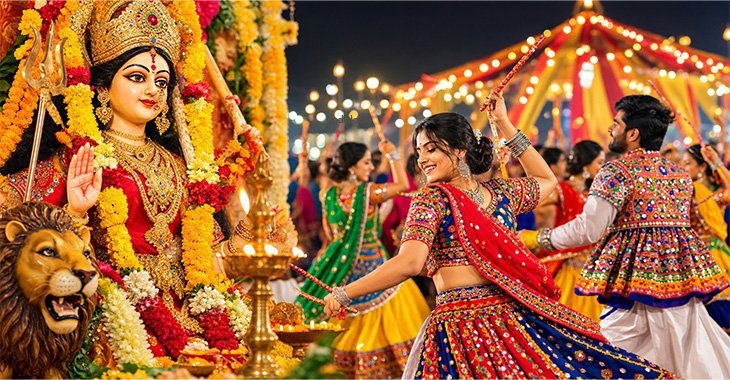
Gujarat is renowned for its energetic Navaratri celebrations, particularly its traditional Garba and Dandiya Raas dances. As evening approaches, communities gather in open grounds, cultural venues and neighbourhood spaces to dance around an image or symbolic representation of the Goddess.
Garba traditionally involves dancers moving in circles around a centrally placed lamp or an earthen pot known as a garbo. The circular movements represent the cycle of life, while the light symbolises divine energy. Dandiya Raas involves pairs of dancers striking decorated wooden sticks in rhythm with traditional music.
Participants wear colourful attire, including embroidered chaniya cholis, kediyus and turbans. Folk singers, percussionists and contemporary musicians create an atmosphere that continues late into the night in many places.
Cities such as Ahmedabad, Vadodara, Surat and Rajkot host large public celebrations, attracting residents and visitors alike. While modern events often feature elaborate stages and professional performers, neighbourhood Garba gatherings retain the festival’s community-centred spirit.
2. West Bengal: Durga Puja Becomes a Grand Cultural Celebration
In West Bengal, Navaratri overlaps with the spectacular celebrations of Durga Puja. Although the festival begins earlier in the lunar calendar through rituals such as Mahalaya, the main festivities take place during the final days of Navaratri.
Kolkata transforms into a vast cultural landscape filled with beautifully designed pandals, artistic installations, decorative lighting and idols of Goddess Durga. Organisers often draw inspiration from historical architecture, folk art, contemporary themes and social issues to create distinctive displays.
Devotees offer flowers, perform prayers and participate in pushpanjali, a ritual offering of flowers to the Goddess. Dhak drummers provide the distinctive rhythms associated with Durga Puja, while cultural programmes, traditional food stalls and family gatherings bring neighbourhoods together.
The festival culminates in Vijayadashami, when devotees bid farewell to the Goddess and immerse her idol in a river or another designated water body, following local customs and environmental regulations.
Durga Puja is not only a religious observance in Bengal but also a major expression of artistic creativity, community identity and shared cultural heritage.
3. Karnataka: Mysuru Dasara Celebrates Royal Heritage
Karnataka celebrates Navaratri with particular grandeur in Mysuru, where Mysuru Dasara preserves traditions associated with the former royal family of the region.
The Mysuru Palace receives elaborate illumination, and cultural performances, music programmes, exhibitions and sporting events contribute to the festive atmosphere. The celebrations honour Goddess Chamundeshwari, a form of Durga associated with Chamundi Hill and the city’s religious traditions.
One of the festival’s best-known attractions is the Jumboo Savari, the traditional Vijayadashami procession featuring a decorated elephant carrying the idol of Goddess Chamundeshwari in a golden howdah. The procession also showcases folk performers, tableaux, traditional music and cultural groups.
Beyond Mysuru, many Karnataka households observe Navaratri through daily worship and the display of dolls, commonly known as Gombe Habba or Bombe Habba. Families arrange figurines representing deities, mythological stories, animals and everyday life on stepped platforms. They invite relatives and neighbours to view the displays and exchange festive greetings.
4. Tamil Nadu: Golu Displays and Devotional Worship
Tamil Nadu celebrates Navaratri through a distinctive combination of religious observances, music and artistic traditions. One of its most recognisable customs is Golu, a display of dolls arranged on an odd number of steps in many households.
The dolls may represent Hindu deities, mythological characters, saints, animals, village scenes and contemporary social themes. Families often preserve and expand their collections over several generations, making Golu an important part of household heritage.
Women and children frequently visit neighbouring homes to view the displays, sing devotional songs and exchange sundal, a snack commonly prepared with legumes such as chickpeas, green gram or black-eyed peas.
Temples organise special pujas for Goddess Durga, Lakshmi and Saraswati during the nine days. The final three days are often associated respectively with the worship of Durga, Lakshmi and Saraswati, although specific practices vary between communities.
The festival concludes with Vijayadashami, which many families consider an auspicious occasion to introduce children to learning through the ceremony known as Vidyarambham or Aksharabhyasam in different traditions.
5. Andhra Pradesh and Telangana: Bathukamma and Regional Traditions
Andhra Pradesh and Telangana celebrate Navaratri with devotional rituals, temple visits and distinctive regional customs. Telangana is particularly famous for Bathukamma, a floral festival that often coincides with the Navaratri period, depending on the lunar calendar.
Women arrange seasonal flowers in colourful, tiered formations and gather in circles to sing traditional Bathukamma songs. They celebrate the beauty of nature, feminine energy and community relationships. The festivities culminate in the ceremonial immersion of the floral arrangements in water bodies, subject to local practices.
In Andhra Pradesh, devotees visit temples dedicated to Goddess Durga and participate in special prayers during the festival. The Kanaka Durga Temple in Vijayawada attracts large numbers of pilgrims, with the Goddess worshipped in different forms during the celebrations.
Both states reflect how regional traditions enrich Navaratri while preserving the shared emphasis on devotion, family participation and the power of the Goddess.
6. Maharashtra: Ghatasthapana and Community Celebrations
In Maharashtra, Navaratri begins with Ghatasthapana, a ritual that symbolises the invocation of divine energy. Families establish a sacred pot or vessel in their prayer spaces and perform daily worship throughout the festival.
Devotees observe fasts, recite prayers and visit temples dedicated to Goddess Durga. Many communities also organise Garba and Dandiya programmes, reflecting the influence of neighbouring Gujarat’s dance traditions.
Married women in some communities arrange Haldi-Kumkum gatherings, where they exchange turmeric, vermilion and festive greetings. These gatherings strengthen social connections and offer opportunities for women to participate in shared cultural activities.
The tenth day, Vijayadashami, holds special significance for beginning new ventures, purchasing important items and seeking blessings for prosperity and success.
7. Northern India: Fasting, Ramleela and Dussehra
Across northern India, Navaratri combines the worship of Goddess Durga with traditions associated with Lord Rama. Many devotees observe fasts, visit temples and recite religious texts during the nine days.
In Uttar Pradesh, Delhi, Haryana and parts of other northern states, communities stage Ramleela, dramatic performances depicting episodes from the Ramayana. These performances often culminate in the victory of Lord Rama over Ravana.
On Dussehra, organisers burn large effigies of Ravana, Meghnad and Kumbhakarna to symbolise the destruction of evil. Public grounds attract families who gather to watch the performances, processions and fireworks where permitted.
In Himachal Pradesh, the Kullu Dussehra festival follows a distinctive tradition. Celebrations begin on Vijayadashami and continue for several days, bringing together local deities, processions and community gatherings.
These regional variations demonstrate how Navaratri connects the worship of the Goddess with wider stories of righteousness and moral responsibility.
8. Kerala: Saraswati Puja and the Celebration of Learning
Kerala observes Navaratri with a strong emphasis on Goddess Saraswati, the Hindu deity associated with knowledge, music, arts and learning.
During the final days of the festival, families and temples arrange books, musical instruments and other learning materials for worship. Many devotees observe Puja Vayppu, during which they place books and educational materials before the Goddess.
On Vijayadashami, children participate in Vidyarambham, a ceremony that marks the beginning of formal learning. An elder or teacher traditionally guides the child in writing initial letters, often on rice or another suitable surface.
Temples and cultural institutions also organise classical music, dance and devotional programmes. The observance highlights the belief that education and artistic knowledge deserve reverence and disciplined practice.
Fasting, Food and Daily Rituals During Navaratri
Food forms an important part of Navaratri observances. Many devotees fast for one or more days, while others follow specific dietary restrictions throughout the nine-day period.
Common fasting foods include fruits, milk, yoghurt, nuts, potatoes and dishes prepared with buckwheat or water chestnut flour, depending on regional customs. Some devotees avoid grains, onions, garlic and certain other ingredients during their fasts.
Households prepare special offerings for the Goddess and distribute prasad among family members and visitors. In different regions, these offerings may include sweets, fruits, coconut, payasam, halwa or traditional savoury dishes.
Daily worship often involves lighting lamps, offering flowers, chanting mantras and reading religious texts. Some families perform Kanya Puja, in which young girls receive worship, food and gifts as symbolic representations of the Goddess. The ceremony is particularly associated with the final days of Navaratri in several northern Indian traditions.
Practices differ according to family customs, religious beliefs and local traditions. Devotees generally approach fasting and worship as expressions of discipline, gratitude and spiritual commitment.
The Role of Music, Dance and Community Participation
Navaratri brings religious devotion into public spaces through music, dance and collective celebrations. Garba, Dandiya, classical dance performances, devotional singing and folk music help preserve traditions while introducing them to younger generations.
Schools, cultural organisations and residential communities often arrange competitions, performances and themed events. Traditional clothing, handmade decorations and regional cuisine add to the festive atmosphere.
The festival also creates opportunities for artisans, musicians, flower sellers, food vendors, costume designers and event organisers. Seasonal markets and cultural programmes support local economic activity, while tourism introduces visitors to regional customs.
At the same time, many communities increasingly promote environmentally responsible celebrations. Organisers encourage the use of natural or recyclable decorations, responsible waste disposal and idols made from eco-friendly materials. Such efforts help protect local surroundings while preserving the festival’s cultural richness.
The Message of Navaratri in Modern India
Although Navaratri draws upon ancient religious traditions, its central messages remain relevant to contemporary life. The victory of Goddess Durga over Mahishasura represents the courage to confront injustice, challenge harmful behaviour and overcome personal difficulties.
The worship of the Goddess also highlights feminine strength and the importance of respecting women’s contributions to families, communities and society. The celebration of Saraswati emphasises education and knowledge, while the worship of Lakshmi reflects aspirations for prosperity and well-being.
Navaratri also encourages people to reconnect with their families, neighbours and cultural roots. Whether through a small household puja, a community Garba event, a Durga Puja pandal or a traditional Golu display, participation creates opportunities to share customs and strengthen social bonds.
Modern celebrations increasingly combine traditional rituals with contemporary music, artistic expression and digital communication. Despite these changes, devotion and community participation continue to define the festival.
Conclusion
Navaratri represents far more than nine nights of religious observance. It brings together India’s diverse traditions through the worship of divine feminine energy, the celebration of good over evil and the preservation of regional cultural heritage.
From Gujarat’s energetic Garba to West Bengal’s magnificent Durga Puja, Karnataka’s royal Mysuru Dasara, Tamil Nadu’s Golu displays and Kerala’s Saraswati Puja, every region contributes a distinctive expression to the festival.
These celebrations share a common spirit of faith, courage, learning and unity. As families and communities welcome Navaratri each year, they renew their connection with age-old traditions while carrying their values into modern life. The festival’s enduring appeal lies in its ability to unite devotion, cultural diversity and the universal hope that goodness and righteousness will ultimately prevail.