


As countries around the world strive to reduce carbon emissions, cut dependence on imported crude oil, and promote cleaner transportation, ethanol-blended fuels have become an important part of the energy transition.
In India, fuel stations have increasingly begun offering petrol blended with ethanol under labels such as E10 and E20, while discussions around E50, E85, and even higher ethanol blends continue to gain momentum.
Many vehicle owners, however, remain confused about what these labels actually mean.
Questions such as “Will E20 damage my engine?“, “Is ethanol better than petrol?“, “Can I use E50 in my current car?“, and “Will fuel efficiency decrease?” are becoming increasingly common.
Understanding ethanol blends is essential because they affect not only vehicle performance but also fuel economy, maintenance costs, environmental impact, and the nation’s energy security.
This article explains everything you need to know about E10, E20, E50, and other ethanol blends, along with their advantages, disadvantages, and future prospects.
What Does “E” Mean in Fuel?
The letter “E” stands for Ethanol, an alcohol-based renewable fuel produced from plant materials such as:
- Sugarcane
- Corn (Maize)
- Broken rice
- Wheat
- Agricultural biomass
- Cellulosic waste
The number following the “E” indicates the percentage of ethanol blended with petrol.
For example:
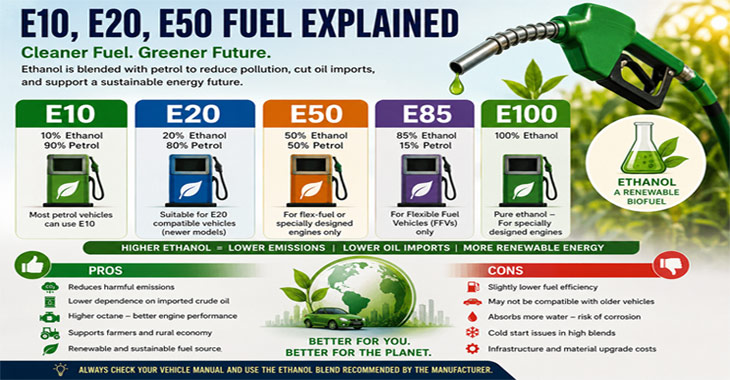
E10 = 10% Ethanol + 90% Petrol
E20 = 20% Ethanol + 80% Petrol
E50 = 50% Ethanol + 50% Petrol
E85 = 85% Ethanol + 15% Petrol
E100 = Pure Ethanol
These blends are primarily used in petrol-powered vehicles.
Why Is Ethanol Mixed with Petrol?
There are several reasons governments encourage ethanol blending:
- Reduce dependence on imported crude oil
- Lower greenhouse gas emissions
- Support farmers by creating demand for agricultural produce
- Improve fuel security
- Reduce foreign exchange expenditure
- Promote renewable energy
India imports nearly 85% of its crude oil requirement. Increasing ethanol blending helps reduce this dependence while supporting domestic agriculture.
Understanding Different Ethanol Blends
E5
E5 contains:
- 5% Ethanol
- 95% Petrol
It was among the earliest ethanol blends introduced in several countries and generally requires no vehicle modifications.
Suitable For
Almost all petrol vehicles.
E10
E10 contains:
- 10% Ethanol
- 90% Petrol
This is currently one of the most common ethanol blends globally.
Advantages
- Cleaner combustion
- Reduced emissions
- Better octane rating
- Compatible with most petrol engines
Most modern cars manufactured during the last decade are designed to operate safely on E10.
E20
E20 consists of:
- 20% Ethanol
- 80% Petrol
India has been progressively introducing E20 fuel as part of its national ethanol blending initiative.
Vehicle manufacturers have also started producing E20-compatible vehicles, with many newer models designed to operate efficiently on this blend.
E50
E50 contains:
- 50% Ethanol
- 50% Petrol
This blend is significantly richer in ethanol and is generally intended for specially engineered engines.
Standard petrol vehicles are typically not designed to run on E50 unless approved by the manufacturer.
E85
E85 contains:
- 85% Ethanol
- 15% Petrol
It is commonly used in Flexible Fuel Vehicles (FFVs) that can operate on petrol, ethanol, or any combination of both.
Countries such as Brazil and the United States have long adopted E85-compatible vehicles.
E100
E100 is pure ethanol.
Only specially designed engines can use this fuel safely.
Brazil is among the leading countries using high-percentage ethanol fuels.
Why Is Ethanol Considered Cleaner?
Ethanol contains oxygen in its chemical structure.
This helps fuel burn more completely, resulting in:
- Lower carbon monoxide emissions
- Reduced hydrocarbon emissions
- Less particulate pollution
- Lower greenhouse gas emissions
Because ethanol is produced from renewable crops, it is considered a renewable fuel source.
Advantages of Ethanol-Blended Fuels
1. Reduced Carbon Emissions
One of ethanol’s biggest advantages is reducing harmful emissions.
Compared to conventional petrol, ethanol blends can lower:
- Carbon monoxide
- Unburnt hydrocarbons
- Certain greenhouse gases
This contributes to cleaner urban air and improved environmental outcomes.
2. Reduced Oil Imports
Countries that import large quantities of crude oil benefit from producing ethanol domestically.
For India, this translates into:
- Lower import bills
- Reduced exposure to global oil price fluctuations
- Improved energy security
3. Better Octane Rating
Ethanol has a naturally high octane number.
Higher octane fuel helps:
- Reduce engine knocking
- Improve combustion quality
- Enhance performance in engines designed for higher octane fuels
4. Support for Farmers
Ethanol production creates additional markets for agricultural products.
Farmers growing crops such as:
- Sugarcane
- Maize
- Rice
- Wheat
can benefit from increased demand, potentially improving rural incomes.
5. Renewable Fuel
Unlike crude oil, ethanol is renewable.
Each agricultural season provides fresh feedstock for ethanol production.
6. Economic Benefits
Expanding ethanol production can stimulate:
- Rural employment
- Distillery investments
- Biofuel infrastructure
- Logistics and supply chains
Disadvantages of Ethanol-Blended Fuel
Although ethanol offers several benefits, it also presents some challenges.
1. Lower Fuel Efficiency
Ethanol contains less energy than petrol.
This means vehicles may experience:
- Slightly lower mileage
- Increased fuel consumption per kilometer
The difference is usually modest with E10 but becomes more noticeable with higher blends such as E50 or E85.
2. Compatibility Issues
Older vehicles may not be compatible with higher ethanol blends.
Potential issues include:
- Rubber seal degradation
- Corrosion of certain metal components
- Fuel line damage
- Injector problems
Manufacturers generally specify which ethanol blends are safe for each model.
3. Higher Water Absorption
Ethanol is hygroscopic, meaning it absorbs moisture from the air.
Excess water can lead to:
- Fuel contamination
- Corrosion
- Engine performance issues if fuel is stored for long periods
4. Cold Weather Starting
High ethanol blends can make cold starts more difficult in colder climates due to ethanol’s lower volatility.
5. Infrastructure Costs
Introducing higher ethanol blends requires:
- Storage modifications
- Fuel station upgrades
- Distribution adjustments
- Quality control systems
These changes involve additional investment.
6. Food vs Fuel Debate
Some critics argue that using food crops for fuel production may affect food availability or prices.
Supporters counter that improved agricultural productivity, diversified feedstocks, and the use of crop residues can help address these concerns.
Is E20 Safe for Existing Vehicles?
This is one of the most frequently asked questions.
The answer depends on the vehicle.
Generally:
- Most newer petrol vehicles are designed or certified for E20 compatibility.
- Many older vehicles are optimized for E10 and may not be suitable for prolonged use with E20 without manufacturer approval.
Vehicle owners should always consult the owner’s manual or the manufacturer’s recommendations before using higher ethanol blends.
Can E50 Be Used in Regular Cars?
Generally, NO.
E50 requires engines specifically engineered to handle higher ethanol concentrations.
Using E50 in a vehicle not designed for it may lead to:
- Poor combustion
- Engine warning lights
- Fuel system damage
- Reduced performance
- Long-term maintenance issues
Always follow the fuel specifications provided by the manufacturer.
Impact on Vehicle Maintenance
Higher ethanol blends may require more attention to:
- Fuel filters
- Fuel pumps
- Fuel injectors
- Rubber hoses
- Fuel seals
Vehicles designed for higher ethanol blends typically use ethanol-resistant materials to mitigate these effects.
Ethanol Blending in India
India has made ethanol blending a strategic priority.
Key objectives include:
- Reducing crude oil imports
- Enhancing farmer income
- Promoting renewable energy
- Lowering vehicular emissions
- Strengthening energy security
The country has progressively increased ethanol blending levels over the past decade, supported by investments in distilleries, agricultural supply chains, and fuel distribution infrastructure. Automobile manufacturers have also introduced vehicles compatible with higher ethanol blends to align with these goals.
Global Adoption of Ethanol Fuel
Several countries have embraced ethanol blending to varying degrees.
Brazil
Brazil is a global leader in ethanol use, with widespread adoption of flexible-fuel vehicles capable of running on high ethanol blends.
United States
The U.S. commonly uses E10 nationwide, while E15 and E85 are available in many regions for compatible vehicles.
European Countries
Many European nations use E5 or E10 as standard petrol blends while exploring higher renewable fuel targets.
Future of Ethanol Fuels
The future of ethanol extends beyond simply increasing blending percentages.
Emerging developments include:
- Second-generation (2G) ethanol made from agricultural waste and non-food biomass
- Third-generation biofuels derived from advanced feedstocks such as algae
- Improved flexible-fuel engine technologies
- Integration with hybrid powertrains
- Sustainable aviation fuels using ethanol-derived components
As technology evolves, ethanol is expected to remain an important part of the transition toward cleaner mobility, alongside electric vehicles, hydrogen, and other low-carbon solutions.
Tips for Consumers
If you own a petrol vehicle:
- Check your owner’s manual to determine the approved ethanol blend.
- Use fuel from reputable filling stations.
- Avoid long-term storage of ethanol-blended fuel in vehicles or equipment.
- Follow recommended maintenance schedules.
- Monitor fuel economy if switching to a higher ethanol blend.
- Consult your manufacturer before using blends above the approved level.
Conclusion
Ethanol-blended fuels such as E10, E20, and E50 represent an important step toward reducing emissions, improving energy security, and supporting agricultural economies. Lower blends like E10 are widely compatible with existing petrol vehicles, while E20 is becoming increasingly common in newer models designed for it.
Higher blends such as E50 and E85 offer greater environmental benefits but generally require specially engineered or flexible-fuel vehicles.
For consumers, the key is understanding what fuel their vehicle is designed to use. While ethanol can contribute to cleaner air and reduced dependence on fossil fuels, using a blend that exceeds a vehicle’s compatibility can lead to performance and maintenance issues.
As governments and manufacturers continue investing in biofuel technologies, ethanol is expected to play a significant role in the global transition toward more sustainable transportation.
Whether you’re a daily commuter, a fleet operator, or simply interested in cleaner mobility, understanding ethanol blends empowers you to make informed choices that balance environmental responsibility, vehicle health, and long-term operating costs.